
Kuwait University Language Teaching Center Scholarship 2026–27 | Study Arabic in Kuwait
 Follow us on Facebook
 Join our WhatsApp Channel
 Subscribe on YouTube
Arabic is one of the six official languages of the United Nations. It is spoken natively by over 300 million people across 22 countries. It is the language of the QURAN, of centuries of scholarship, of some of the world’s fastest-growing economies, and of an entire region where Pakistani professionals have built careers for generations.
Yet most Pakistani students who want to learn Arabic properly — not just recitation, but real spoken and written proficiency — have very limited options at home. Classes are short. Exposure is minimal. And without hearing and using the language every day, progress is slow.
Kuwait University’s Language Teaching Center offers Pakistani students a structured, merit-based scholarship to study Arabic in Kuwait — where the language is not a subject but the surrounding reality. This guide explains everything: why Kuwait, what the scholarship covers, who can apply, how HEC’s selection works, what documents you need, and exactly how to prepare.
Study Arabic in Kuwait for Pakistani Students
| Detail | Information |
|---|---|
| Program Name | Kuwait University Language Teaching Center Scholarship 2026–27 |
| Managing Body | Higher Education Commission (HEC) Pakistan |
| Host Institution | Kuwait University, Kuwait |
| Application Portal | scholarship.hec.gov.pk |
| Selection Basis | Academic merit only — HSSC marks (SSC as tiebreaker) |
| Application Type | Online only — incomplete or saved applications are rejected |
Why Learn Arabic — And Why It Matters More Than Most Students Realize
The assumption that Arabic is only relevant for religious study is outdated and limiting. Arabic is the official language of the Arab League, a working language of the African Union, and one of the UN’s six official languages. It is the primary language of business, law, media, and government across 22 countries spanning the Middle East and North Africa.
For Pakistani students specifically, Arabic proficiency opens doors that English alone cannot. Gulf countries — Saudi Arabia, the UAE, Kuwait, Qatar, Bahrain, Oman — are among the largest employers of Pakistani professionals worldwide. Arabic-speaking professionals consistently earn more, advance faster, and access roles that remain closed to those without the language. In sectors like law, diplomacy, international trade, Islamic finance, translation, journalism, and academia, Arabic is not just useful — it is often essential.
Beyond career impact, there is the scholarly dimension. For students of Islamic studies, Quranic sciences, hadith, fiqh, or classical Islamic literature, functional Arabic is not optional — it is the foundation everything else rests on. A student who can read and understand original Arabic sources has a depth of access that no translation can replace.
Why Kuwait — What Makes It Different From Learning Arabic at Home
Language acquisition research consistently shows one finding: immersion accelerates learning faster than any classroom-based method alone. When a student is surrounded by a language — hearing it in lectures, reading it on signs, using it to buy groceries, navigating it in conversation with people who speak nothing else — progress happens at a different pace entirely.
Kuwait is a Gulf state where Modern Standard Arabic and Kuwaiti Arabic are the languages of daily life. Government offices function in Arabic. Universities teach in Arabic. Public life is conducted in Arabic. For a student who moves there specifically to learn the language, every hour outside the classroom becomes an extension of the lesson.
Kuwait University specifically is one of the Gulf’s most established academic institutions with a structured Arabic language program through its Language Teaching Center. The curriculum is designed for international students at different proficiency levels — so prior Arabic knowledge, while helpful, is not a barrier to starting.
What the Kuwait Environment Provides That Home Cannot
Daily immersion in spoken Arabic. Every interaction outside the university — transportation, shops, public spaces, social settings — requires Arabic. Students who engage with this environment rather than retreating to Pakistani communities find their listening and speaking skills improve dramatically within weeks.
Academic instruction in Arabic. Learning Arabic at a university where everything — administration, instruction, signage — is in Arabic means constant reinforcement of what is being studied in class.
Cultural understanding alongside language. Language and culture are inseparable. Students who live in an Arab country develop an understanding of communication styles, social norms, and cultural references that makes their Arabic functionally richer than anything a purely academic approach produces.
International academic network. Kuwait University attracts students from across the Muslim world and beyond. The professional relationships built during this period — with fellow students, faculty, and academic contacts — often prove valuable for years after the program ends.
Eligibility Requirements to Study Arabic in Kuwait
The eligibility criteria for Arabic language programs at Kuwait University through HEC are generally focused on recent graduates or those who have completed intermediate-level education, with selection based entirely on academic merit. While specific requirements may be confirmed on the HEC portal when the program is active, the following reflects what these programs typically require:
- Nationality: Pakistani citizen
- Education: Higher Secondary School Certificate (HSSC / Intermediate) completed
- Selection Basis: HSSC marks — purely merit-based, no interview or test
- Tiebreaker: If HSSC marks are equal between candidates, SSC (Matric) marks are used
- Medical Fitness: Generally required for international programs
- Prior Arabic Knowledge: Not necessarily required — programs are structured for learners at different levels
The purely merit-based nature of HEC’s selection process is significant. There is no interview, no language test, no letter of recommendation required at the application stage. Your HSSC marks alone determine your position on the merit list. This makes academic performance the single most important factor — and means that a student with strong grades has a genuinely competitive chance regardless of other circumstances.
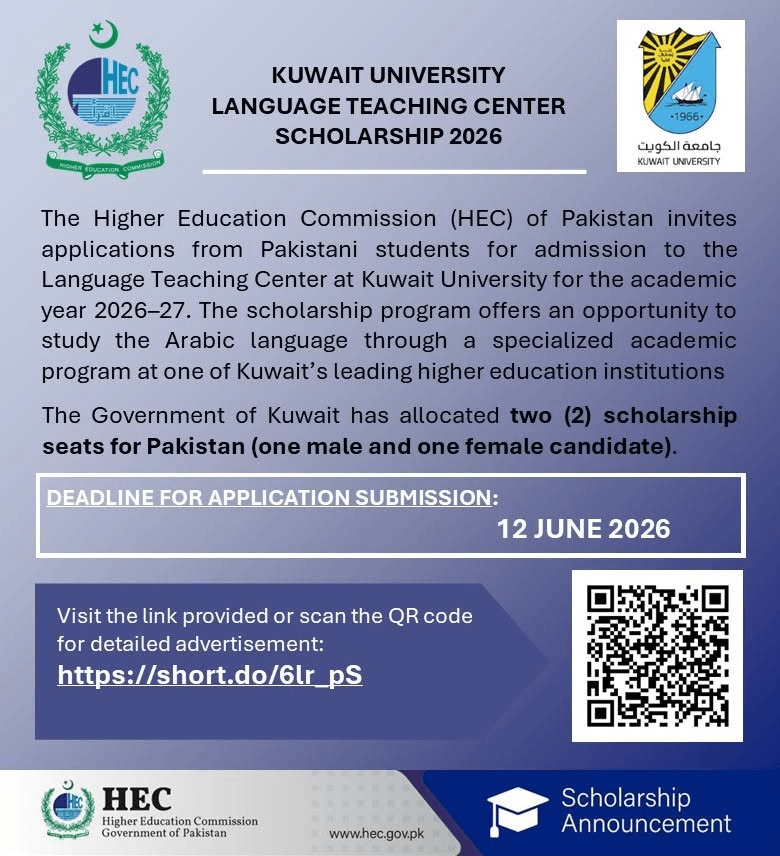
How to Apply for Kuwait University Language Teaching Center Scholarship 2026–27
The application process runs entirely through HEC’s online portal. Understanding each step in advance — including what the most common failure points are — significantly increases the chances of a successful submission.
Critical rule before you begin: Only fully submitted applications are considered. An application that is saved but not submitted is treated as if it does not exist. HEC’s system automatically rejects incomplete submissions. There are no exceptions to this.
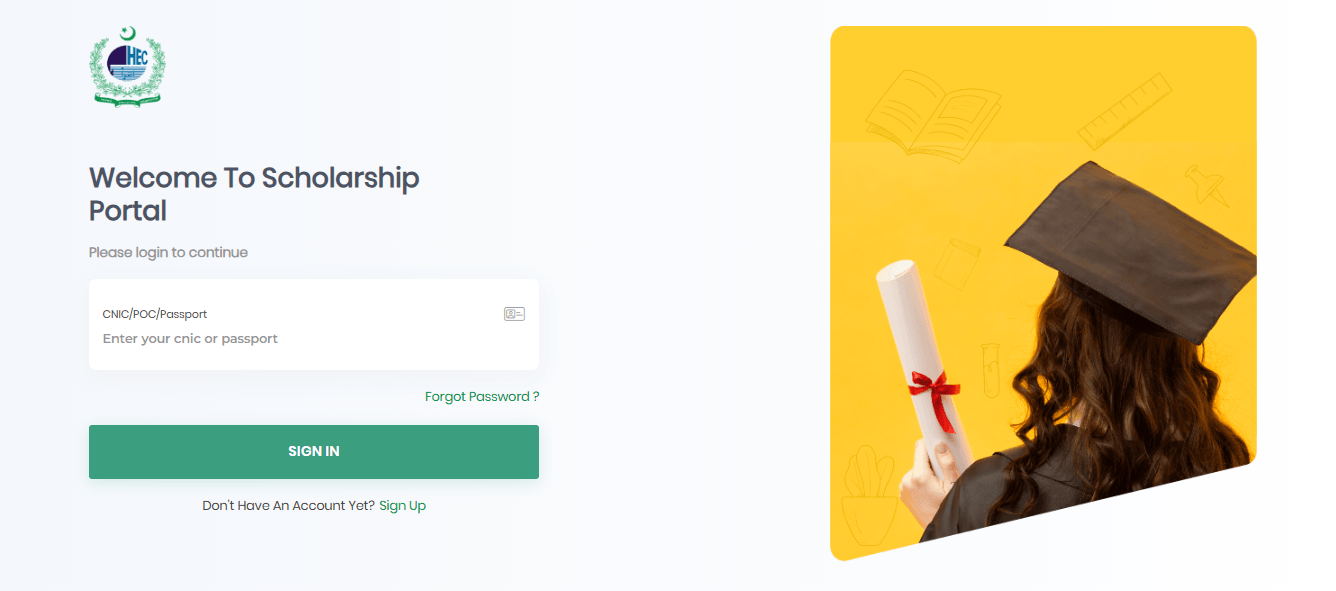
Create Your HEC Profile at scholarship.hec.gov.pk
Visit the official HEC scholarship portal at https://scholarship.hec.gov.pk and create your personal profile. This is your only official application channel — no other website, form, or process is valid.
When creating your profile, enter your information exactly as it appears on your official documents. This means:
- Your full name — exactly as on your CNIC, not a nickname or shortened version
- Your CNIC number — correct and matching your national identity card
- Your education details — matching your certificates precisely
Navigate to “Learning Opportunities Abroad (LOA)”
After logging into your dashboard, find and select the section titled “Learning Opportunities Abroad (LOA)”. From within this section, locate and select the program titled Kuwait University Language Teaching Center Scholarship 2026–27. This is the specific category your application must be submitted under. Applying under the wrong category will result in your application not being considered for this program.
Fill the Application Form With Complete Accuracy
This is the step where most avoidable errors occur. Fill every field completely and correctly. Specifically:
- Academic history — enter every qualification accurately, including institution names, years, and results
- HSSC marks — enter the exact marks from your certificate, not an estimated or rounded figure
- Personal information — consistent with what you entered in your profile
- Spelling — check every name, institution, and detail for accuracy
Because selection is based purely on HSSC marks, an incorrectly entered mark — even a single digit error — can place you incorrectly on the merit list or cause your application to fail verification entirely. Check everything at least twice before moving to the next step.
Submit the Application and Print a Copy Immediately
Once you are satisfied that everything is correct, submit the application through the portal. Immediately after submission, print a copy of the submitted application form and keep it in a safe place. This printed copy is your proof of submission and will be required if you are shortlisted and asked to provide hard copies of documents. Do not assume you can print it later — always do it immediately after submission.
Wait for Merit-Based Shortlisting
After the application window closes, HEC reviews all submitted applications and builds a merit list. Students are ranked by HSSC marks — highest to lowest. Where two candidates have identical HSSC marks, SSC (Matric) marks are used as the tiebreaker.
Only shortlisted candidates are contacted and asked to submit physical copies of their documents. If you are not contacted, your application was not selected in the current round. This does not mean you are ineligible for future opportunities — many students are selected in subsequent rounds or program years after reapplying.
Kuwait University Language Teaching Center Scholarship 2026–27 Deadline:
Application Deadline: 12 June 2026
Program Start Date: 13 September 2026
Study Duration: Three Academic Terms (First Semester, Second Semester and Summer Semester)
Application Mode: Online through HEC Scholarship Portal
Selection Basis: Academic Merit Only
Important: Scholarship deadlines change every year. Even if you miss the current application cycle, keep monitoring official HEC announcements because similar opportunities may open again in future years.
Merit Selection System — How HEC Ranks Candidates
Understanding exactly how the merit list works allows students to assess their own competitiveness honestly and make informed decisions about when and how to apply.
The purely academic merit system means there is no room for connections, recommendations, or subjective evaluation. A student with strong HSSC marks competes on a level playing field with every other applicant in Pakistan. This makes the system genuinely fair — and means that every percentage point in your academic results has a direct impact on your position in the selection process.
Documents to Prepare Before Applying to Study in Kuwait
While only shortlisted candidates are asked for physical document submission, preparing everything in advance is strongly advisable. Students who are shortlisted and cannot quickly produce their documents risk losing their place. Have all of the following ready before the application window opens:
One document deserves special attention: your passport. If your passport is expired, close to expiry, or you do not have one at all — begin that process immediately. Passport processing in Pakistan can take weeks, and delays here have cost shortlisted candidates their spots before.
Mistakes That Cost Students Their Selection
HEC processes thousands of applications for these programs. The errors that eliminate otherwise qualified candidates are, without exception, avoidable:
| 1. | Saving the application without submitting it. This is the single most common mistake. The portal allows you to save progress — but a saved application is not a submitted application. HEC’s system treats an unsubmitted application as non-existent. Always confirm submission and print immediately after. |
| 2. | Entering incorrect marks. Since selection is based entirely on HSSC marks, entering an incorrect figure — even accidentally — directly distorts your position on the merit list. Cross-check with your original mark sheet before every submission. |
| 3. | Information that does not match official documents. If the name in your application does not exactly match your CNIC, or your marks differ from your certificate, your application fails verification. Every field must match official records precisely. |
| 4. | Not having a valid passport when shortlisted. Being selected and then unable to proceed because of passport issues is a painful and entirely avoidable situation. If your passport is not current, begin renewal now — not after you receive a shortlisting notification. |
| 5. | Applying at the last minute. HEC portals experience high traffic near deadlines. Technical issues, slow connections, and system delays have caused last-minute submissions to fail. Apply before the 12 June 2026. |
| 6. | Not monitoring HEC announcements. These programs open without much advance notice. Students who check the HEC scholarship portal and official channels regularly are the ones who catch announcements in time. Checking once a month is not enough — check weekly during application seasons. |
You may also be interested in: CM Punjab Tourism Internship Program Phase 2 – Complete Guide
Student Life in Kuwait — What to Realistically Expect
Studying abroad is a significant life experience — one that most students find more rewarding than they anticipated, but also more challenging than they expected. Going in with realistic expectations makes the adjustment faster and the overall experience better.
The First Weeks
- Almost every international student goes through a period of adjustment in the first few weeks. The language is everywhere and overwhelming. Daily tasks that were automatic at home — buying food, finding your way around, understanding instructions — require real effort. This is normal and it passes. Students who push through this early period rather than retreating into Pakistani expat communities almost universally report that it was the period when their Arabic improved the fastest.
Independent Living Skills
- For many students, this will be the first time managing their own finances, schedule, meals, and daily responsibilities. Managing a budget in a foreign currency, planning weekly expenses, dealing with administrative processes in a bureaucratic system — these experiences build practical life competence that follows a person far beyond the scholarship period.
Cultural Environment
- Kuwait is a Muslim-majority country with a Gulf Arab culture. Pakistani students generally find the religious environment familiar and comfortable. However, Kuwaiti social customs, workplace culture, and communication styles are distinct from Pakistani norms in ways that require some adjustment and cultural sensitivity. Students who approach this with curiosity rather than judgment gain the most from the experience.
Professional Connections Built for Life
- Kuwait University attracts students from across the Arab world, South Asia, and beyond. The professional connections formed during this period — with fellow students, faculty members, and academic contacts — represent a network that can support career development for decades. Students who take these relationships seriously rather than treating them as a temporary convenience often find that the network turns out to be as valuable as the qualification itself.
You may also be interested in: NFT 5 MMA National Championship 2026 Registration Open | Apply Now
Frequently Asked Questions
Do I need to know Arabic before applying?
Not necessarily. The Kuwait University Language Teaching Center is specifically designed to teach Arabic to international students at different proficiency levels. Some prior exposure to Arabic is helpful but is not typically a stated eligibility requirement. Confirm current requirements on the HEC portal when the program is active.
Is there an interview or language test as part of selection?
No. HEC’s selection for this program is based purely on academic merit — HSSC marks — with no interview, entrance exam, or language test at the application stage. Your marks alone determine your position on the merit list.
What if I was not selected this time?
This program runs annually. Not being selected in one round does not affect your eligibility in future rounds. Many successful scholarship recipients applied more than once before being selected. Monitor HEC’s official portal and channels for each new cycle.
What is the difference between saving and submitting an application?
Saving stores your progress in the portal but does not submit it. HEC only considers applications that have been fully submitted through the portal. A saved but unsubmitted application is treated as if it does not exist. Always confirm submission and print a copy immediately afterward.
When should I start preparing documents?
Now — regardless of whether the program is currently open. Documents like medical certificates and passport renewals take time. Students who begin preparing before an announcement is made are always in a better position than those who scramble after a deadline appears.
You may also be interested in: HEC Short Video Contest 2026 for Pakistani Students – Full Guide | Apply Now
Complete Action Plan — What to Do Right Now
Step 1: Focus on your HSSC performance — it is the only thing that determines your position on the merit list
Step 2: Gather your HSSC and SSC mark sheets, certificates, and CNIC — have them physically in hand
Step 3: Check your passport. If it is expired, close to expiry, or missing — begin the renewal process today
Step 4: Create your profile at scholarship.hec.gov.pk so you are ready to apply the moment the program opens
Step 5: Monitor HEC’s official portal and announcements regularly — these programs open without much advance notice
Step 6: Begin building basic Arabic familiarity now — apps, short courses, online resources. It will not affect selection but will make the transition significantly smoother
Step 7: When the program opens — apply early, check every detail, submit fully, and print immediately
The opportunity is real. The process is straightforward. The barrier is preparation.
HEC’s Kuwait University Arabic scholarship selects candidates on academic merit alone — no connections, no interviews, no subjective evaluation. A Pakistani student with strong HSSC marks and correctly submitted documentation has a genuine, competitive shot at studying Arabic in Kuwait at no personal expense.
The students who miss these opportunities are not the ones with lower marks. They are the ones who found out too late, whose passport was not ready, whose application was saved but never submitted, or who entered one field incorrectly and failed verification.
Start preparing now. Monitor scholarship.hec.gov.pk regularly. When the window opens — be ready.