
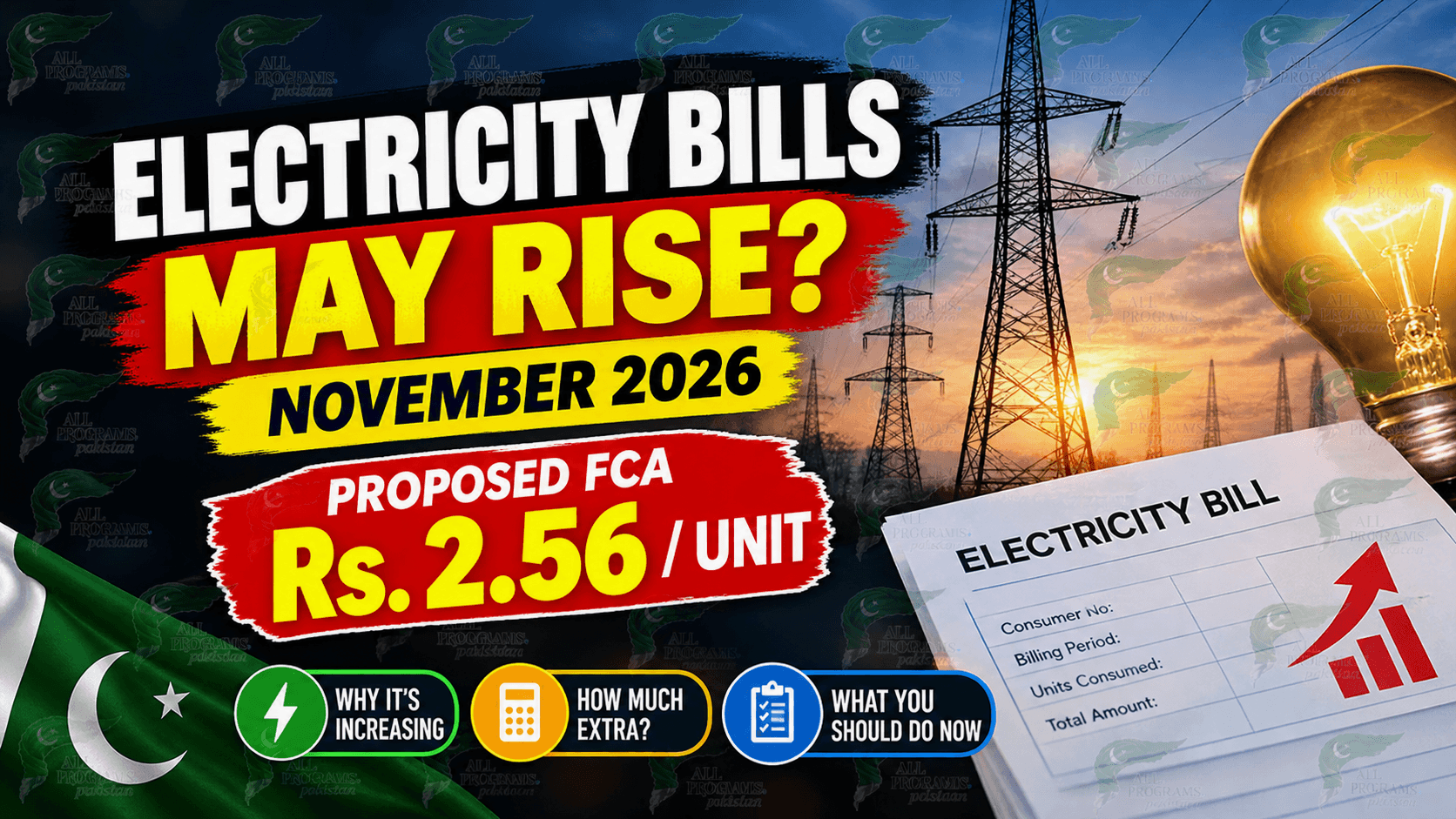
Pakistan Electricity Bills May Rise in November 2026
 Follow us on Facebook
 Join our WhatsApp Channel
 Subscribe on YouTube
The projected adjustment is Rs. 1.45 per unit higher than the Rs. 1.11 per unit FCA for August consumption. According to the Power Division, rising international fuel prices and limited LNG supplies have increased electricity generation costs. The division also says that targeted load management helped prevent an even bigger increase.
But what does this mean for your household budget? Will every consumer have to pay the additional amount, and what should you do before your November electricity bill arrives? Here is everything you need to know.
Quick Summary: November Electricity Bills 2026
- Projected FCA: Rs. 2.56 per unit.
- Electricity consumption month: September 2026.
- Expected billing month: November 2026.
- Estimated financial impact: Rs. 32.7 billion nationwide.
- Previous FCA: Rs. 1.11 per unit for August consumption.
- Increase in FCA rate: Rs. 1.45 per unit.
- Final approval: The projected rate should not be treated as the final regulatory determination.
- What consumers should do: Check official updates, monitor electricity consumption and review the FCA entry on the bill.
November Electricity Bills 2026: What Has Been Announced?
On October 15, 2026, the Power Division projected a September Fuel Price Adjustment of Rs. 2.56 per unit, which is expected to affect electricity bills issued in November.
The projected rate is higher than the Rs. 1.11 per unit adjustment for August consumption. The Power Division estimates that the September adjustment could result in an additional financial burden of Rs. 32.7 billion across consumers.
However, consumers should understand one important point: the figure announced by the Power Division is a projection. The applicable final rate and any exemptions or special conditions must be confirmed through the relevant regulatory decision and notification.
Rs. 2.56 per unit is the projected FCA, not a confirmed final charge. Do not assume that every consumer will pay this amount under identical conditions. Check the official notification for the applicable rate, consumer categories and exemptions.
How Much Extra Could You Pay on Your Electricity Bill?
If the projected FCA of Rs. 2.56 per unit is approved and applies to your billed units, you can estimate its direct impact using a simple calculation.
Estimated FCA = Applicable Units × Rs. 2.56
For example, if you consume 300 units and the full projected rate applies to those units, the FCA component would be Rs. 768 before taxes and other applicable charges.
| Units Consumed | Estimated FCA |
|---|---|
| 50 units | Rs. 128 |
| 100 units | Rs. 256 |
| 200 units | Rs. 512 |
| 300 units | Rs. 768 |
| 400 units | Rs. 1,024 |
| 500 units | Rs. 1,280 |
| 700 units | Rs. 1,792 |
Remember: These figures are estimates for understanding the possible FCA impact. They are not complete electricity bill totals. Taxes, other tariff adjustments, applicable exemptions and the final approved rate can change the actual amount payable.
Why Is the FCA Increasing in November?
The Power Division has attributed the projected increase to rising international fuel prices and constraints on LNG supplies. These developments have put pressure on the cost of generating electricity.
1. International Fuel Prices Have Increased
According to the Power Division, Brent crude oil prices rose above $120 per barrel, compared with the approximately $70 per barrel benchmark used when calculating the base electricity tariff.
When electricity generation becomes more expensive because of higher fuel costs, the difference between actual and reference fuel costs can affect the FCA.
2. LNG Supply Constraints Have Added Pressure
Pakistan also faces challenges related to LNG availability. The Power Division said that despite Qatar declaring force majeure, Pakistan continued efforts to secure RLNG through available contracted supplies and additional spot cargoes where needed.
Limited supplies can increase pressure on electricity generation costs, particularly when more expensive fuels are needed to produce electricity.
3. Expensive Fuels Can Increase Generation Costs
The Power Division said that greater reliance on expensive fuels, including furnace oil and high-speed diesel, could have pushed the September adjustment even higher.
It estimated that the adjustment could otherwise have reached Rs. 5 to Rs. 6 per unit. The division attributed the lower projected rate to targeted load management and other measures. This is the government’s stated assessment, rather than a separate confirmed tariff.
How Did Load Management Help Limit the Expected Increase?
According to the Power Division, targeted load management during September helped reduce the need to generate electricity using expensive fuels.
The division said electricity supply was restricted for approximately two to two-and-a-half hours daily. It claimed that these measures reduced reliance on furnace oil and high-speed diesel and helped contain the projected adjustment.
The division also said that supplying imported re-gasified liquefied natural gas (RLNG) to power plants at domestic gas prices reduced the estimated adjustment by 83 paisa per unit.
According to its statement, the measures helped avoid a potential increase of up to Rs. 3.44 per unit, with the projected adjustment remaining at Rs. 2.56 per unit rather than the estimated Rs. 5–6 per unit.
What Should Electricity Consumers Do Now?
If you are concerned about your November electricity bill, there are a few practical steps you can take now. You do not need to rush into any registration process or pay anyone for special FCA relief.
Step 1: Do Not Apply for Unannounced FCA Relief
The projected FCA is a tariff adjustment, not a newly announced financial assistance scheme. The information covered in this report does not establish a separate application process for consumers to avoid the projected charge.
If someone claims that you can remove the FCA from your bill by paying a fee or registering through an unofficial website, verify the claim before taking any action.
Step 2: Reduce Unnecessary Electricity Consumption
You cannot control international fuel prices, but you can review your household electricity use.
- Switch off lights and fans when they are not needed.
- Use air conditioners carefully and avoid unnecessarily low temperature settings.
- Reduce standby consumption by switching off equipment that does not need to remain powered.
- Use energy-efficient lights and maintain your appliances properly.
- Monitor daily meter readings to identify unusually high consumption.
Reducing electricity consumption can help control the consumption-related portion of your bill. However, it does not guarantee a lower FCA rate per unit.
Step 3: Check Your November Bill Carefully
When your November bill arrives, do not look only at the total amount. Review the details to understand what you are being charged for.
- Check the meter readings and total billed units.
- Confirm the billing period.
- Review the FCA rate and the units to which it applies.
- Check quarterly tariff adjustments and other additional charges.
- Review taxes, duties, arrears and payments already credited.
- Confirm the due date and total amount payable.
If your bill is much higher than expected, compare the readings and individual charges with your previous bill. The increase may involve more than one billing component.
Step 4: Wait for the Official Regulatory Notification
The projected Rs. 2.56 per unit rate should not be treated as final until the applicable regulatory process is completed and the relevant notification is issued.
Consumers should follow announcements from the National Electric Power Regulatory Authority (NEPRA), the Power Division and their electricity distribution company.
Step 5: File a Complaint If Your Bill Is Incorrect
If you believe the FCA has been calculated incorrectly, compare the charge with the applicable official notification and check the billing period and units.
- Keep a copy of your electricity bill and note your reference number.
- Identify the specific charge or calculation you believe is incorrect.
- Contact your electricity distribution company using the official contact details printed on your bill.
- Request a complaint reference number and keep a record of the response.
- If the issue remains unresolved, check the complaint procedure through the official NEPRA website.
A complaint can help address a billing error, but it does not automatically exempt you from a valid, officially approved adjustment.
Fraud Alert for Electricity Consumers
Do not share your CNIC details, banking passwords or one-time passwords with unknown callers. Avoid paying agents who promise guaranteed FCA exemptions or government relief that has not been officially announced.
Always verify electricity billing information through official channels.
Will Every Consumer Have to Pay Rs. 2.56 Per Unit?
Consumers should not automatically assume that the projected rate will apply to every category under identical conditions.
The final regulatory notification will determine the applicable rate, covered consumer categories and any exemptions or special conditions. Previous FCA decisions have included exemptions for certain categories, but earlier decisions do not confirm which exemptions will apply to the September 2026 adjustment.
Household, commercial and industrial consumers should check the final notification rather than assume that the projected amount applies to every bill in exactly the same way.
What Is the Latest Update on the Industrial Electricity Support Package?
The Power Division also discussed the combined impact of fuel price adjustments and quarterly tariff adjustments during January to August 2026. It said the combined impact had been limited to 65 paisa per unit, equivalent to 1.9% of the base electricity tariff.
The division attributed this partly to tariff rationalisation and an additional electricity consumption package for industrial and agricultural consumers.
However, industrial consumers have challenged the claimed benefits of the incremental consumption package. They argue that the marginal rate of Rs. 22.96 per unit benefits a limited group, while an estimated marginal cost of around Rs. 34 per unit leaves a difference of about Rs. 11 per unit that is passed into the average tariff.
Following a request from industrial consumers, NEPRA held a public hearing on whether the package should be revised or suspended. As reported on October 16, 2026, a decision was still awaited.
This is a separate issue from the projected September FCA. Consumers should wait for the relevant official decision before drawing conclusions about any changes to the industrial package.
You may also like: Pakistan E-Passport Fees 2026 – 5 & 10 Years, Normal & Urgent
Frequently Asked Questions (FAQs)
1. What is the projected FCA for November 2026 electricity bills?
The Power Division has projected an FCA of Rs. 2.56 per unit for electricity consumed in September 2026. The applicable final rate depends on the regulatory process and official notification.
2. How much extra could I pay for 300 units?
At the projected rate of Rs. 2.56 per unit, 300 units would produce an estimated FCA of Rs. 768 before taxes and other applicable charges, provided the full rate applies to those units.
3. Has the Rs. 2.56 per unit FCA been finally approved?
The reports published on October 15–16, 2026, describe Rs. 2.56 as the Power Division’s projected adjustment. Consumers should check the applicable regulatory notification for the final rate and conditions.
4. Why is the FCA higher than the August adjustment?
The projected September FCA is Rs. 1.45 per unit higher than August’s Rs. 1.11 per unit adjustment. The Power Division has linked the increase to higher international fuel prices and constraints on LNG supplies.
5. Do I need to apply to avoid the FCA?
No separate application process to avoid the projected FCA has been announced in the information covered by this report. Be cautious of anyone offering guaranteed exemptions in exchange for money.
6. Can I reduce my FCA by using fewer electricity units?
Using fewer units can reduce the estimated rupee impact when the same per-unit adjustment applies. However, the FCA rate itself depends on fuel costs and the applicable regulatory calculation.
7. What should I do if my electricity bill is incorrect?
Check your meter readings, billed units, billing period and the relevant official notification. If the charge still appears incorrect, contact your electricity provider using the official details on your bill and keep your complaint reference.
8. Where can I check official FCA updates?
You can visit the NEPRA website for regulatory information and contact your electricity distribution company for billing-specific queries.
9. What does the Rs. 32.7 billion figure mean?
It is the estimated aggregate financial impact across electricity consumers, according to the Power Division. It is not an additional charge of Rs. 32.7 billion for any individual consumer.
10. Why does the Power Division say a bigger increase was avoided?
The division says targeted load management and supplying imported RLNG to power plants at domestic gas prices helped limit the projected adjustment. It estimated that the increase could otherwise have reached Rs. 5–6 per unit.
Final Words
The projected Rs. 2.56 per unit FCA could put additional pressure on electricity consumers’ budgets in November 2026. The Power Division estimates a nationwide impact of Rs. 32.7 billion and has linked the projected increase to rising fuel prices and constraints on LNG supplies.
For now, consumers should focus on reducing unnecessary electricity use, monitoring their meter readings and checking official announcements. Once the November bill arrives, review the FCA entry and other charges carefully rather than assuming that the entire increase has a single cause.
Stay connected with AllPrograms.com.pk for clear updates on electricity bills, government announcements and public services that affect your daily life.