Green Property Certificate (GPC) Punjab — Complete Guide
 Follow us on Facebook
 Join our WhatsApp Channel
 Subscribe on YouTube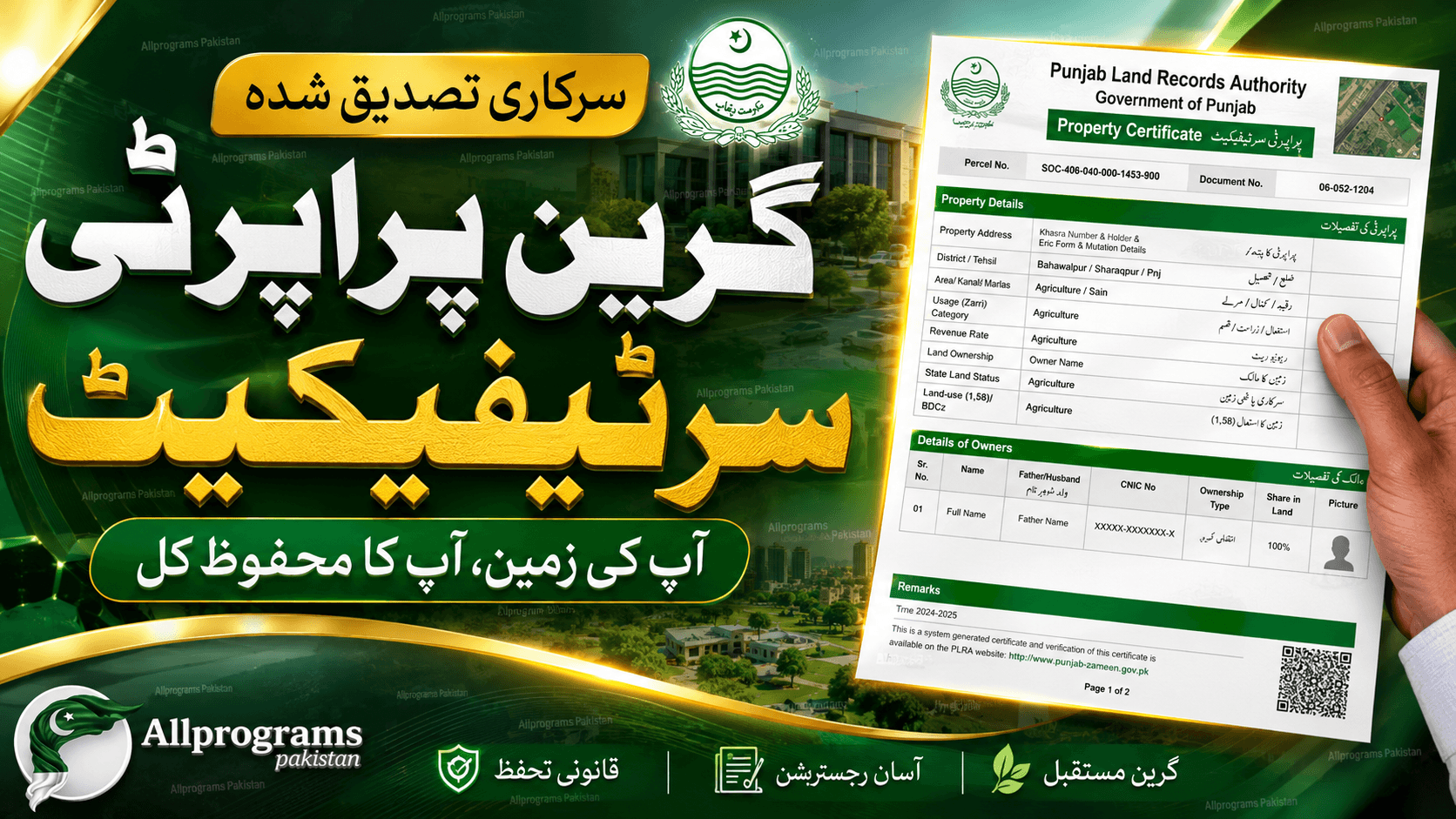
For 486 years, land ownership records in Punjab worked more or less the same way — a paper “Fard,” easy to forge, easy to lose, and genuinely hard to fully trust. Now, A New has officialy begin. The Punjab Government and the Punjab Land Records Authority (PLRA) have introduce a new digital, QR-coded document: the Green Property Certificate.
If you own land, a house, a plot, or any property in Punjab, this is one of the best legally recognised document for buying, selling, or transferring it. In this guide, we’ll walk through absolutely everything about the Green Property Certificate — what it is, why it better than the old Fard, exactly how the 10-step process works, the fee, and answers to nearly every question people ask about it.
What Is the Green Property Certificate?
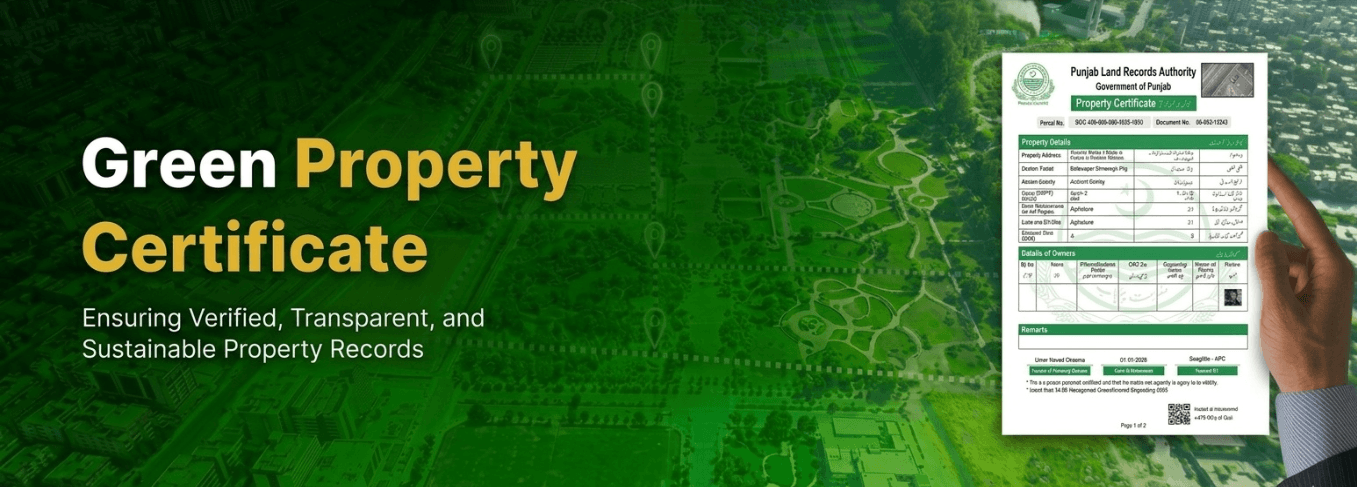
The Green Property Certificate is a modern, electronically generated ownership document that confirms the legal status, ownership, and actual possession of a specific piece of land or property. Unlike the old paper Fard, it links directly to a secure QR code connected to PLRA’s central land registry database, along with a digital map showing exact land coordinates.
It’s issued in both Urdu and English on a single document, and it’s integrated with NADRA records, meaning ownership details are cross-checked against verified national identity data — something the old system never really did properly.
Why Did Punjab Replace the Old Fard System?
The old Fard-based system had a real, well-known weakness: it was relatively easy to forge, and it didn’t actually confirm who physically possessed the land — only what paper records claimed. This created space for property fraud, double-allocation of the same plot, and long, expensive court disputes.
The Green Property Certificate was designed specifically to close these gaps:
- Zero fraud design — QR-coded and GPS-verified, making forgery far harder
- Verifies actual possession — unlike the old Fard, it confirms who genuinely occupies the land, not just who’s named on paper
- Dispute-free process — includes a mandatory 15-day public notice period before issuance, so objections are handled upfront
- Full legal standing — after the applicable deadline, no bank or court accepts the old Fard for property transactions anymore
Green Property Certificate Rollout Timeline
The Green Property Certificate wasn’t launched everywhere at once — PLRA rolled it out in phases to test and refine the system before going province-wide:
According to PLRA’s own official notification (No. PLRA/ADG.ADMIN/162-/2026), the certificate remained mandatory for barely 10 days before the requirement was rolled back.
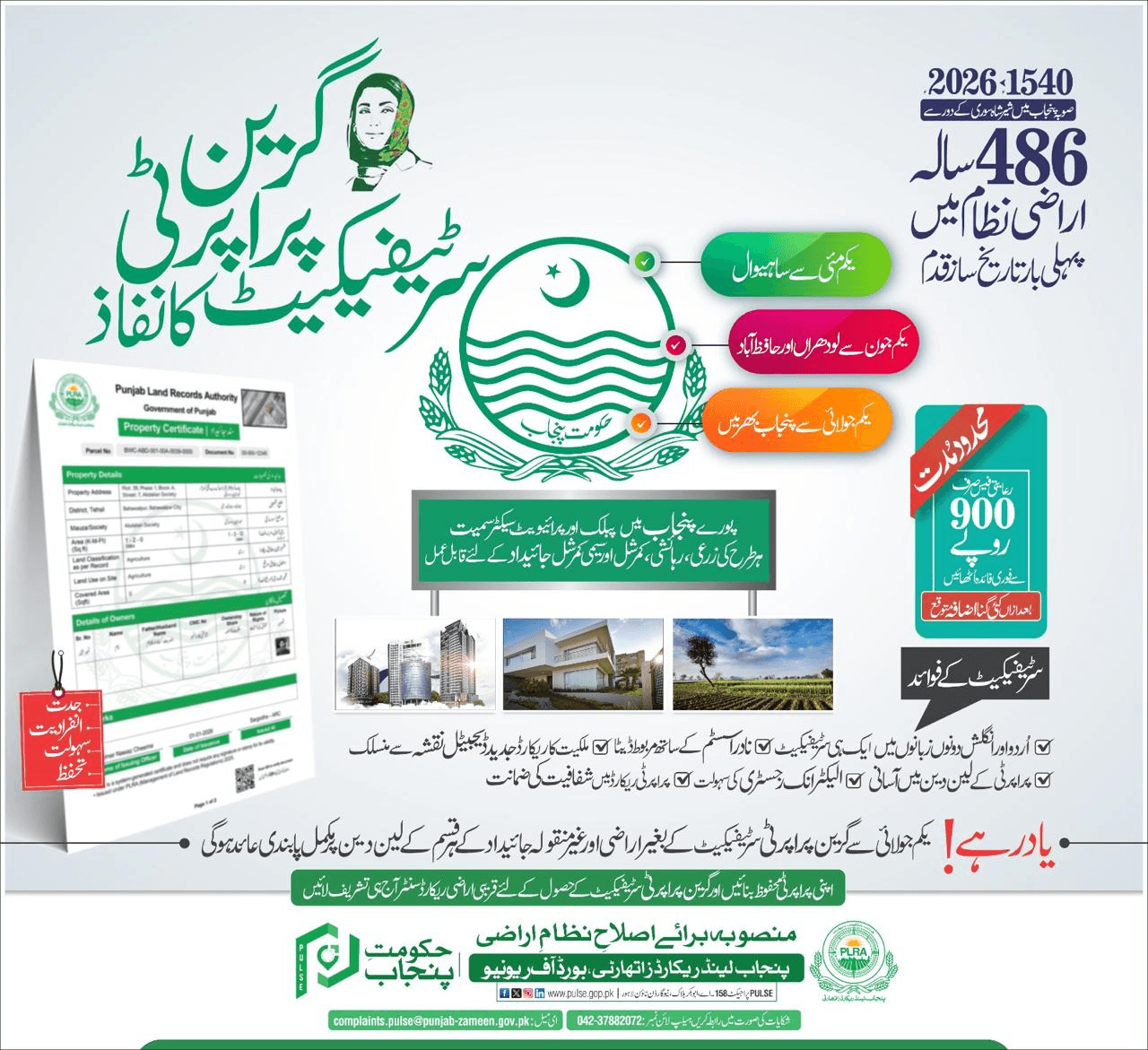
Important Update: The Green Property Certificate (GPC) was made mandatory across Punjab on 1 July 2026, but that mandatory requirement was withdrawn just 10 days later, on 11 July 2026, after citizens faced serious difficulties obtaining it due to incomplete digitisation of land records. As of now, the traditional Fard / Naqal Arazi Record is once again legally valid for property transactions, and the GPC is not currently compulsory. This guide explains both how the GPC system works and the current status — always confirm with PLRA directly before relying on either document for a transaction, since this policy has already changed once and could change again.
Green Property Certificate in Lahore Housing Schemes
One important detail specific to Lahore: since 1 July 2026, in all housing schemes in Lahore — including private housing schemes — the Property Certificate is the only legal ownership document recognised for property transactions. This applies whether the housing scheme is government-run or privately developed.
This Lahore-specific requirement is also affected by the province-wide withdrawal on 11 July 2026. Since the mandatory GPC requirement was rolled back across all of Punjab, this almost certainly applies to Lahore housing schemes too, though PLRA’s public communication has focused on the general province-wide reversal. If you’re dealing with a property transaction in a Lahore housing scheme specifically, confirm the current requirement directly with PLRA or the housing society before assuming either document is sufficient.
Under the new rules, all housing scheme administrations are required to transfer their complete records to the Housing Societies Management System (HSMS), and every housing society must ensure the Property Certificate system is properly implemented within its scheme.
Key Benefits of Getting a Green Property Certificate
- Bilingual certificate — issued in both Urdu and English on one document
- NADRA-integrated data — ownership cross-checked against national identity records
- Linked to a modern digital map — exact land coordinates recorded
- Easier property transactions — buyers, sellers, and banks can verify status instantly
- Electronic registry facility — reduces manual paperwork and delays
- Full transparency in property records, reducing fraud and disputes
Green Property Certificate Fee and Payment Methods
The introductory processing fee for the Green Property Certificate is Rs 900. This is described as a limited-time, discounted rate — the government has indicated the fee is expected to rise significantly later, so applying sooner rather than later is genuinely worth it financially, not just for peace of mind.
You can pay this fee through any of the following:
- The Bank of Punjab (BOP) counter available at your Arazi Record Center
- Any Bank of Punjab branch
- Through a PSID using JazzCash, EasyPaisa, or online banking
How to Get a Green Property Certificate in Punjab? – Complete 10-Step Process
Note: Even though the GPC is not currently mandatory, PLRA has continued issuing it for citizens who want one voluntarily — it still offers genuine benefits like fraud protection and digital verification. The process below reflects how to obtain a GPC if you choose to.
Here’s exactly what happens from the moment you walk into your nearest Arazi Record Center (ARC) to the moment you’re holding your certificate:
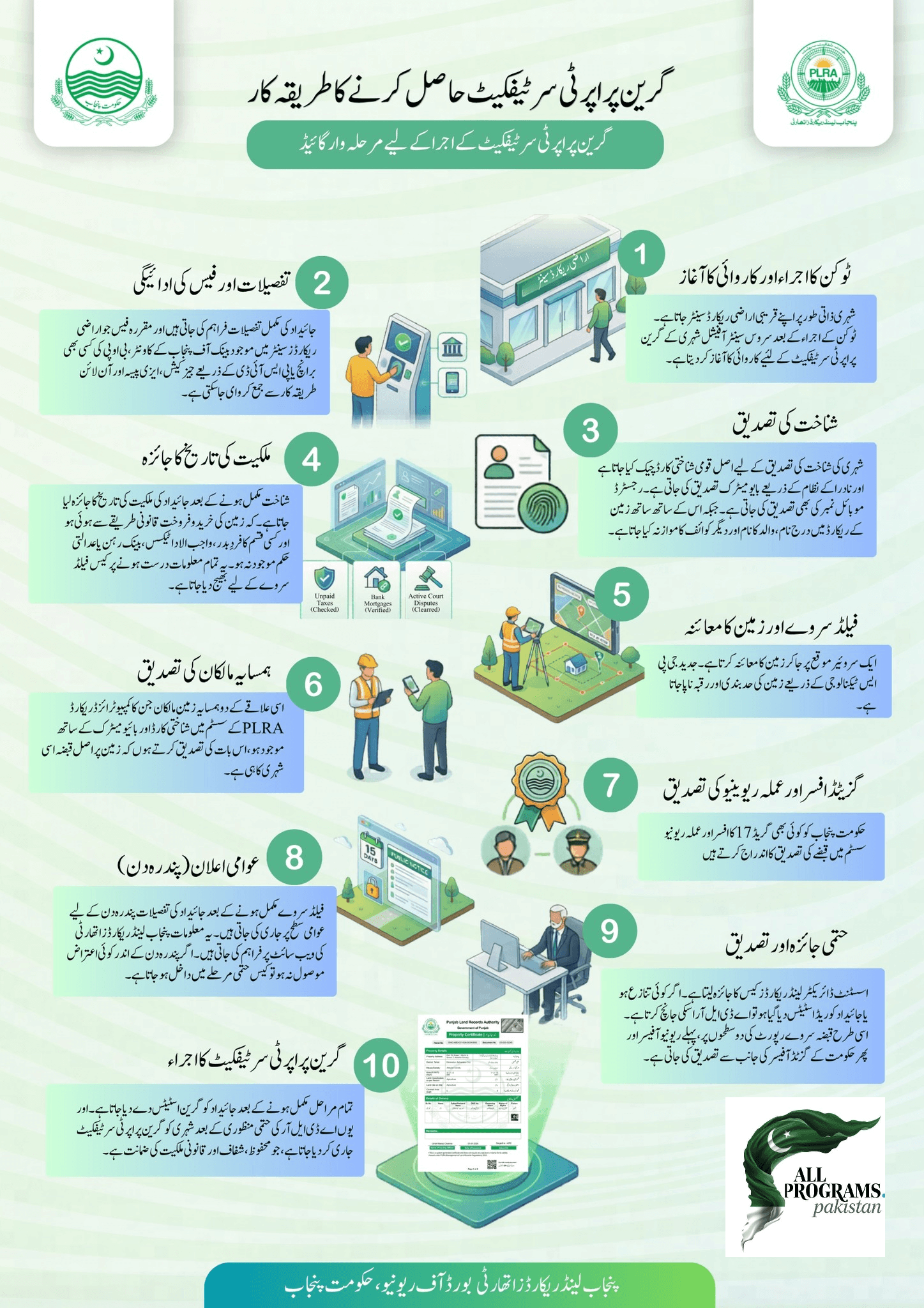
Step 1: Token Issuance and Process Initiation
- Visit your nearest Service Center / Arazi Record Center (ARC) in person — this process cannot be started online. After you receive a token, Service Center staff open your case in the system and officially begin your Green Property Certificate process.
You can easily “Explore Arazi Record Centers Across Punjab here“. Just select your District and Tehsil.
Step 2: Provide Property Details and Pay the Fee
- Give complete details of your land or property at the counter, and pay the Rs 900 fee through any of the payment methods listed above.
Step 3: Identity Verification
- Your original CNIC is checked, and biometric verification is done through the NADRA system. Your registered mobile number is also verified, and your name, father’s name, and other details are matched against existing land records.
Step 4: Ownership Record and Transaction History Review
- Once your identity is confirmed, officials review your property’s ownership and transaction history to confirm all past buying and selling was done legally. They specifically check for unpaid taxes, bank mortgages/encumbrances, and any active court disputes tied to the property. If everything is clear, your case moves forward to a physical field survey.
Step 5: Field Survey and Site Inspection
- A surveyor physically visits the property to inspect it in person, using modern GPS/DGPS technology to measure the exact boundaries and area of the land.
Step 6: Neighbor/Witness Verification
- At least 2 neighboring landowners from the same locality — whose own records already exist in PLRA’s computerized system — must confirm, in person and with biometric verification, that you genuinely possess the land you’re applying for.
Step 7: Gazetted Officer and Revenue Staff Verification
- Any Grade 17 or above officer from the Government of Punjab, along with revenue staff, formally records confirmation of possession in the system.
Step 8: 15-Day Public Notice
- After the field survey, your property’s details are published for 15 days on the PLRA website, giving anyone with a genuine objection the chance to raise it during this window. If no objection is filed within 15 days, your case proceeds to final review.
Step 9: Final Review and Approval
- The Assistant Director Land Records (ADLR) reviews the complete case. If there’s a dispute or the property was previously flagged as “Red Status,” the ADLR investigates it specifically. Possession survey reports are verified at 2 levels — first by a Revenue Officer, then by a designated Government officer.
Step 10: Green Property Certificate Issuance
- Once all stages are complete and the ADLR grants final approval, your property is given “Green” status, and your Green Property Certificate is issued — a secure, transparent, and legally protected proof of your ownership.
Fard System Abolished: How to Get Your Green Property Certificate in Punjab (2026) Video Guide
Types of Property Reports Issued by PLRA
Not every report issued under this system is the same — PLRA issues 3 distinct types, depending on your purpose:
What If My Application Is Rejected?
If your Green Property Certificate cannot be issued, you’ll be given a refusal letter that clearly states the reason for rejection. This isn’t the end of the road — you have 2 options:
- File an appeal before the concerned Assistant Commissioner within 30 days of rejection
- Reapply once you’ve resolved whatever caused the rejection in the first place
How to Verify a Green Property Certificate
Every Green Property Certificate is system-generated and does not require any signature or stamp to be valid — this often surprises people used to the old system. Instead, verification happens digitally: simply scan the QR code printed on the certificate to instantly confirm it’s genuine and matches PLRA’s official records.
Joint Ownership and Agricultural Land — Special Rules
If you co-own property with others, the rules depend heavily on what type of land it is:
- Agricultural land: generally requires consent from all co-owners before a Green Property Certificate can be issued, unless the land has already been formally, legally partitioned
- Residential, commercial, or industrial land: a single co-owner may apply independently, without needing every co-owner’s consent — though local land use and construction laws must still be followed
- If all co-owners agree: the property can proceed through a Transactional Property Report linked to the electronic registry, and once transfer is complete, a Transfer Certificate is issued to all concerned parties
If a co-owner of agricultural land wants a Green Property Certificate but doesn’t have the other co-owners’ consent, legal partition must be completed first under the Punjab Land Revenue Act, 1967, to clearly separate ownership in official records before a certificate can be issued.
Frequently Asked Questions
Where can I apply for a Green Property Certificate?
- You must visit your nearest Arazi Record Center (ARC) in person to start the process — it cannot be initiated online.
What happens to ongoing property transactions once I apply?
- Once the Green Property Certificate process begins for a property, all other transactions related to that property are temporarily suspended until the process concludes.
Are there penalties for officials who violate the rules?
- Yes. Any official found violating rules or legal instructions during this process can face penalties or disciplinary action.
Can a Green Property Certificate be issued for built-up or urban areas?
- Yes, including unplanned developed areas, as long as ownership and possession can be verified through land records. Compliance with local land use and construction laws is still mandatory.
Can one certificate cover multiple Khasra numbers?
- No — each property with clearly defined boundaries and a unique identification number requires its own separate certificate. The exception is developed residential, commercial, or industrial land spanning multiple Khasras, which can sometimes be consolidated into a single unit through parcel-based mapping.
Do I need the old Fard anymore?
- As of now, yes — the traditional Fard / Naqal Arazi Record was restored as a legally valid document on 11 July 2026, after the GPC mandate was withdrawn. The Green Property Certificate is currently optional rather than compulsory, though this could change again, so it’s worth confirming the current requirement with PLRA before any transaction.
Is the Green Property Certificate still mandatory?
- No, not currently. It was mandatory from 1 July 2026 to 11 July 2026, after which PLRA withdrew the requirement, reportedly due to incomplete digitisation of land records across the province.
You may also like: Tenant Registration in Punjab has Become Easier – Here’s How
Official Contact Information
- Website: punjab-zameen.gov.pk | pulse.gop.pk
- Complaints Email: [email protected]
- Helpline: 042-37882072
- Issued By: Punjab Land Records Authority (PLRA), Board of Revenue, Government of Punjab
Final Words — From AllPrograms Pakistan
The Green Property Certificate represents a genuinely significant idea — a real attempt to make property ownership in Punjab harder to fake and easier to trust. Its rocky start, with the mandatory requirement withdrawn just 10 days after launch, shows the government is still working out the practical kinks, particularly around getting land records fully digitised province-wide.
For now, your traditional Fard remains legally valid, so there’s no need to panic if you haven’t obtained a GPC. That said, if you’d still like the added fraud protection and digital verification it offers, PLRA continues to issue it on a voluntary basis. Whatever you decide, always confirm the current legal requirement directly with PLRA before finalising any property transaction — this is a policy that has already changed once, and could change again.
This guide is based on official information from the Punjab Land Records Authority (PLRA) and the Government of Punjab, updated to reflect PLRA’s notification (No. PLRA/ADG.ADMIN/162-/2026) withdrawing the mandatory GPC requirement on 11 July 2026. For the official step-by-step video walkthrough of the GPC process, PLRA has also published an explainer: watch here. Given how recently this policy changed, please verify the current requirement directly with PLRA before relying on this guide for a live transaction.
— Shaukat, AllPrograms.com.pk