
How Overseas Pakistani Teachers and Researchers Can Work with Punjab Universities
 Follow us on Facebook
 Join our WhatsApp Channel
 Subscribe on YouTube
You left Pakistan to build a better career. You did. You are teaching at a university in the UK, or running research at a lab in Canada, or leading a team in the UAE. You have the qualifications, the experience, and the international exposure that took years to earn
But every so often — during a call home, or reading about Pakistan’s universities, or watching a student struggle with something you could answer in five minutes — the same thought appears: I wish I could do something. I wish this knowledge was going somewhere useful.
The Punjab Higher Education Commission (PHEC) overseas Pakistani experts linkage programme is built for exactly this moment. It does not ask you to give up your career abroad. It does not ask you to move back. It asks you to connect — and through that connection, contribute to something that will outlast any single lecture, paper, or project.
This guide explains what the PHEC international linkage initiative is, what it offers overseas Pakistani academics, researchers, and professionals, how to register at linkages.punjabhec.gov.pk, and why right now — during Punjab’s most ambitious higher education reform in a generation — is the most meaningful time to join.
PHEC Overseas Pakistani Experts Linkage Programme 2026
The Punjab Higher Education Commission overseas Pakistani linkage programme is a structured initiative under the Punjab Higher Education Transformation Agenda 2025–2029 — a government-backed, time-bound reform plan to fundamentally improve the quality, research output, global rankings, and institutional governance of Punjab’s universities within the next three to four years.
The central idea is this: Pakistan has produced some of the world’s finest academics, researchers, scientists, engineers, doctors, technologists, and business leaders. Tens of thousands of them now live and work abroad. Their knowledge, networks, and international experience are among Pakistan’s most valuable untapped resources — and for too long, the connection between these overseas Pakistani professionals and their home country’s universities has been informal at best, and completely absent at worst.
PHEC’s linkage initiative changes that. It creates a formal, funded, institutionally supported bridge between overseas Pakistani experts in diaspora communities worldwide and the universities of Punjab — giving both sides something real, structured, and mutually beneficial to build together.
This is not a volunteer scheme or a one-time event. It is a long-term engagement platform backed by the Government of Punjab’s commitment of financial, policy, and institutional resources through 2029. The opportunities it offers — visiting faculty positions, research collaboration grants, fellowship sponsorships, travel grants, international conference support, policy advisory roles, and innovation support — are real, funded, and open right now.
- Programme Name: Punjab Higher Education Commission Overseas Pakistani Linkage Initiative
- Launched By: Punjab Higher Education Commission (PHEC) — Government of Punjab
- Reform Framework: Punjab Higher Education Transformation Agenda 2025–2029
- Registration Portal: https://linkages.punjabhec.gov.pk/register.php
- Who Can Join: Pakistani academics, researchers, professionals, industry leaders, and business experts living abroad
- Seven Priority Areas: Governance, Quality Enhancement, Teaching Excellence, Research Innovation, Financial Sustainability, Civic Engagement, Leadership Development
- Commitment Level: Flexible — visiting faculty, research collaboration, conference support, advisory roles, mentorship, and more
Punjab Higher Education Transformation Agenda 2025–2029 — The Reform That Makes This Opportunity Real
To understand why this initiative matters so much right now, you need to understand what PHEC is trying to accomplish — because the scale of ambition behind the Punjab Higher Education Transformation Agenda 2025–2029 is genuinely significant, and overseas Pakistani experts are at the center of its strategy.
Punjab’s universities are at a critical juncture. Some are producing strong research and capable graduates. But as a system, Punjab’s higher education sector has faced persistent challenges: teaching quality that varies dramatically between institutions, research output that does not yet match the province’s economic and intellectual potential, governance structures that have not kept pace with global best practices, and limited international collaboration that has left Punjab’s universities largely disconnected from the global academic networks that drive innovation everywhere else.
The transformation agenda confronts these challenges directly and systematically across seven priority areas. These are not vague aspirations — they are funded reform pillars with specific targets, institutional accountability, and a four-year timeline backed by the Government of Punjab:
Seven Priority Areas — Punjab Higher Education Transformation Agenda:
| Priority Area | What It Means | Where Overseas Experts Fit |
|---|---|---|
| Governance | Institutional reform, accountability, transparent management | Advisory roles, policy design, governance reform consultancy |
| Quality Enhancement | Academic standards, curriculum improvement, global benchmarking | Curriculum reform, quality assurance guidance, international standards |
| Teaching Excellence | Improving how faculty teach, modern pedagogical methods | Visiting faculty positions, faculty training, teaching workshops |
| Research Innovation | Building research culture, output, global publications | Joint research grants, collaborative publications, innovation projects |
| Financial Sustainability | University financial health, resource diversification | Business and finance expertise, entrepreneurship ecosystem support |
| Civic Engagement | Universities serving communities, public impact of research | Community-focused projects, public health, social development expertise |
| Leadership Development | Building academic and institutional leaders at universities | Mentorship programmes, leadership training, capacity building |
The reason timing matters: the Transformation Agenda runs from 2025 to 2029. It is active now. Overseas Pakistani experts who join in this early phase of the reform have the greatest opportunity to shape its direction and impact — not just participate in something already decided, but genuinely influence how Punjab’s universities evolve over the next several years.

Exclusive Opportunities for Overseas Pakistani Academics and Professionals — What PHEC Actually Offers
This is where the initiative becomes concrete. PHEC has committed to a specific set of funded opportunities for overseas Pakistani experts who register and engage through the linkage programme. These are not promises — they are institutional offerings backed by the Government of Punjab’s financial commitment to the 2025–2029 agenda.
1. Foreign Visiting Faculty Positions at Punjab Universities
Visiting faculty opportunities at leading universities in Punjab allow overseas Pakistani academics to deliver lectures, conduct workshops, run intensive teaching modules, supervise graduate research, and introduce international teaching methodologies to students who rarely encounter a globally experienced educator in person.
The impact of a visiting faculty member from a world-ranked university is disproportionate to the time invested. A single week of intensive teaching by someone with fifteen years of experience at a European or North American institution can introduce concepts, methods, and perspectives that take years to filter through otherwise. For the overseas expert, it strengthens their academic profile, creates a formal affiliation with a Pakistani institution, and builds the kind of grassroots professional relationships in Pakistan that are impossible to develop from a distance.
2. Fellowships and Short-Term Academic Residencies in Pakistan and Abroad
PHEC is sponsoring fellowships and short-term academic or research residencies — both in Pakistan and internationally — for overseas Pakistani experts who want to engage more deeply with Punjab’s universities. These structured residencies allow for extended collaboration: co-developing courses, building research partnerships, training junior faculty, working with postgraduate students, and contributing to institutional reform at a level that a single lecture visit simply cannot achieve.
For a Pakistani academic abroad who has been wanting a structured way to reconnect with Pakistan’s academic system without disrupting their primary career, a sponsored short-term residency offers exactly that balance — meaningful engagement, institutional support, and a defined time commitment that fits around an international career.
3. Collaborative Research and Innovation Grants
One of the most significant offerings is collaborative research and innovation grants that link overseas Pakistani researchers with Punjab universities. These grants fund joint research projects — connecting the technical capacity, international networks, and resource access of an overseas expert with the ground-level data, local expertise, and institutional infrastructure of a Pakistani university research team.
The research areas are wide open across all seven priority areas and across disciplines: agricultural technology, medical sciences, artificial intelligence, materials science, environmental research, public policy, education innovation, and more. For overseas Pakistani researchers who have brilliant projects that need local data, local partners, or local implementation — these grants provide the institutional framework to make that collaboration happen formally, funded, and recognized.
4. Travel Grants and Academic Mobility Support for International Conferences
PHEC offers travel grants and academic mobility support for overseas Pakistani experts to participate in global conferences — and for Pakistani university faculty to attend international academic events where overseas experts are presenting or collaborating. In both directions, this support builds the kind of face-to-face academic relationships that drive long-term research partnerships, joint publications, student exchange programmes, and institutional linkages.
Anyone who has built a serious academic career understands what happens at conferences that cannot happen by email: the spontaneous conversation in a corridor that becomes a co-authored paper, the research team that forms over dinner, the collaboration that begins because two people happened to attend the same session and realized they were working on complementary problems. Travel grants make these encounters possible — and PHEC’s support ensures that Pakistan’s universities are present in the global academic conversations that matter.
5. Policy Design, Governance Reform, and Institutional Advisory Roles
For overseas Pakistani professionals with expertise in institutional governance, public policy, higher education management, quality assurance, accreditation, financial management, or strategic planning — PHEC is actively seeking contributors to policy design and institutional advisory roles at the provincial level. This means contributing directly to the decisions that shape how Punjab’s universities are governed, funded, evaluated, and developed over the next several years.
These advisory contributions can take multiple forms: serving on committees, reviewing policy documents, contributing written recommendations, participating in expert consultations, or joining formal advisory boards. For overseas Pakistani experts with specific governance and policy expertise, this is perhaps the highest-leverage way to contribute — where a single well-constructed recommendation can influence how dozens of universities operate for years.
6. Technical Support, Innovation Infrastructure, and Entrepreneurship Ecosystem Development
For overseas Pakistani professionals in technology, engineering, IT, business, and industry — PHEC is seeking contributions to innovation and entrepreneurship ecosystem development within Punjab’s universities. This includes supporting the creation of technology transfer offices, business incubators, startup support infrastructure, industry-academia linkage programmes, and applied research centres that connect university knowledge to real-world economic development.
Pakistani professionals who have built careers in the global technology or business ecosystem — who understand how Silicon Valley, London’s tech corridor, or Dubai’s business environment actually functions — carry knowledge that is genuinely rare inside Pakistan’s university system. Bringing that knowledge in, even in limited, structured engagements, can accelerate the development of innovation culture within Punjab’s universities by years.
7. International Conference Organization Support in Punjab
PHEC is also supporting overseas Pakistani experts who want to help organize international academic conferences in Punjab — bringing global scholars, researchers, and practitioners to Pakistan’s universities and elevating Punjab’s academic institutions into internationally recognized venues for serious scholarly exchange. For overseas Pakistani academics with the international networks to attract global participation, this is a powerful way to create lasting institutional impact.
Who Should Register — Which Overseas Pakistani Professionals Will Benefit Most
One of the most common misunderstandings about academic linkage programmes is that they are only for senior professors at top-ranked universities. That assumption is wrong here. The PHEC overseas linkage initiative is explicitly designed to engage a broad range of Pakistani expertise — because the seven priority areas of the Transformation Agenda span every field, every level of seniority, and every type of professional background.

The honest answer to “am I senior enough to contribute?” is this: if you have knowledge, experience, or networks that Punjab’s universities currently lack, you are the right person. A postdoctoral researcher at a top global institution brings methodological knowledge that is rare in Pakistan. A Pakistani professional with fifteen years in European industry carries applied knowledge that no textbook contains. Both are genuinely valuable — and both have a place in this initiative.
How to Register on PHEC Linkage Portal — Complete Step-by-Step Guide
Registration on the PHEC overseas linkage portal at linkages.punjabhec.gov.pk is entirely online, straightforward, and takes approximately fifteen to twenty minutes if you have your information ready. Here is exactly how to do it — section by section — so you can complete it in one sitting without confusion.
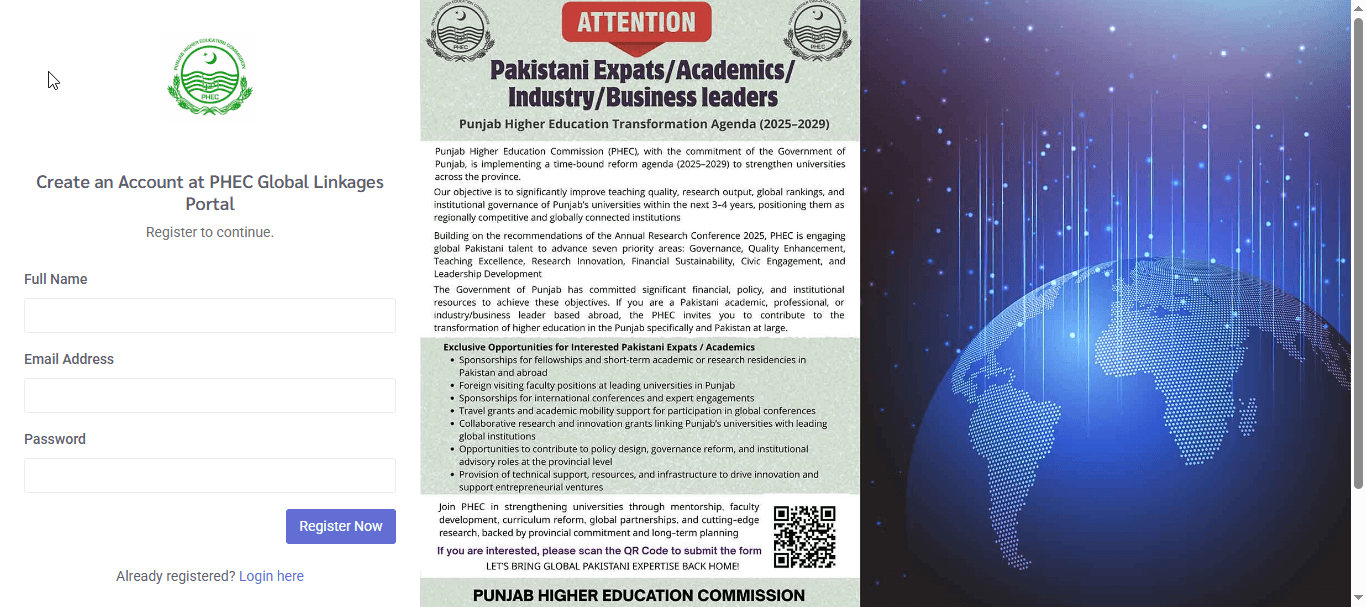
Visit the Registration Page and Create Your Account
Go to https://linkages.punjabhec.gov.pk/register.php — this is the official PHEC overseas Pakistani linkage registration portal. Create your account using your full name, email address, and a secure password. Use an email address you actively monitor — all PHEC communications, opportunity notifications, and collaboration requests will arrive here.
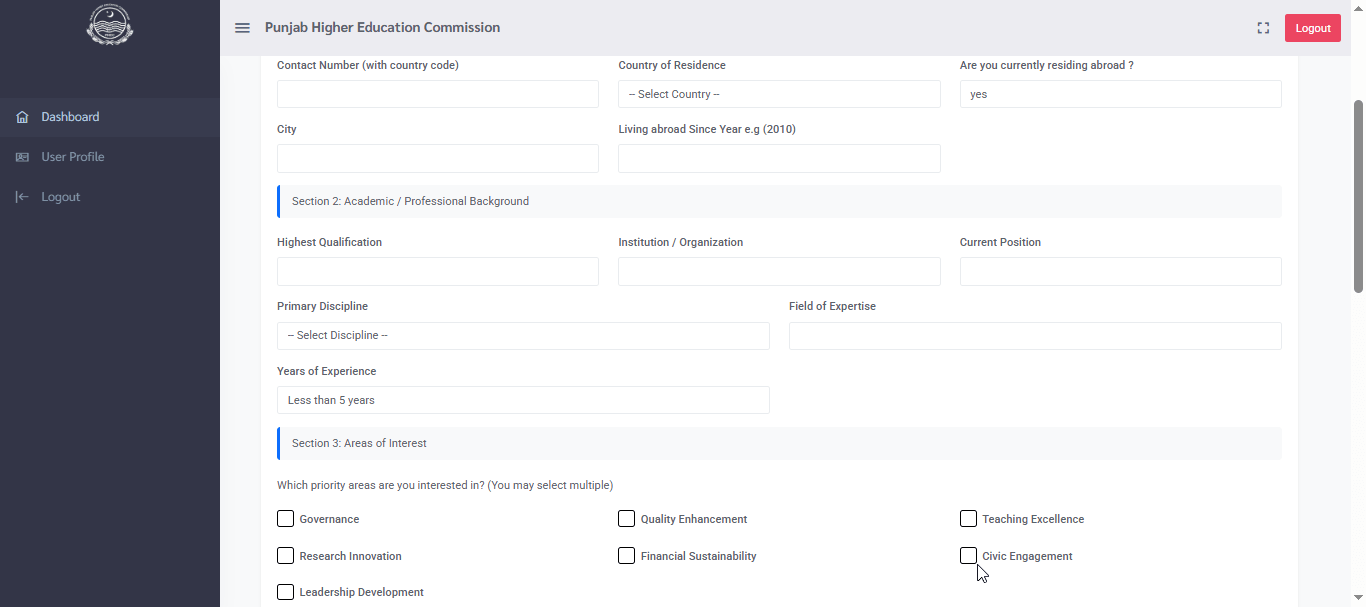
Section 1 — Fill Your Contact Information Accurately
After login, the application form opens. Section 1 asks for basic contact and location information. Fill each field carefully:
- Full Name — as it appears on your passport or official identification
- Email — your primary professional or academic email
- Contact Number with country code — e.g. +44 for UK, +1 for USA/Canada, +971 for UAE
- Country of Residence — select from the dropdown (covers all countries globally)
- Are you currently residing abroad? — select Yes
- City of current residence
- Living abroad since year — enter the year you moved abroad, e.g. 2010, 2015
Section 2 — Enter Your Academic and Professional Background
This section builds your professional profile — the information PHEC uses to match you with relevant opportunities and connect you with the right universities and research teams. Take it seriously and be specific:
- Highest Qualification — your terminal degree (PhD, MD, MBA, MSc, etc.)
- Institution / Organization — where you currently work or your most recent major employer
- Current Position — your actual job title, e.g. Associate Professor, Senior Research Scientist, Director of Engineering
- Primary Discipline — select from 25 discipline categories including Computer Science and IT, Medical and Health Sciences, Engineering and Technology, Business and Finance, Artificial Intelligence and Data Science, Environmental Sciences, and many others
- Field of Expertise — be specific here, e.g. “Machine learning applications in healthcare” or “Climate-resilient crop genetics” rather than just “Biology”
- Years of Experience — select from: Less than 5, 5–10, 10–15, 15–20, More than 20 years
Section 3 — Select Priority Areas and Describe Your Contribution
This is the most important section of the form. You can select multiple priority areas from the seven pillars of the Transformation Agenda. For each area you select, you are signalling your interest and relevance. After selecting, you must answer two critical questions in free text:
- “Please describe how you can contribute to strengthening the higher education sector of Punjab in the areas you selected.” — Write a focused, specific answer. Do not be vague. Name the actual knowledge, methods, networks, or experience you bring. Two to four strong sentences that are concrete and specific are worth far more than ten sentences of generic enthusiasm.
- “Have you previously collaborated with any university or organization in Pakistan? If yes, briefly describe.” — If you have, mention it specifically. Past collaboration demonstrates existing engagement and strengthens your profile significantly.
You also select from a detailed list of opportunity preferences — visiting faculty, fellowship and residency, travel grants, conference support, research collaboration grants, faculty and student exchange, consultancy, and capacity building / training. Select every option that genuinely interests you — this is not a commitment, it is an expression of interest that helps PHEC direct the right opportunities to your profile.
Section 4 — Upload CV and Add LinkedIn Profile
In the final section, add your LinkedIn or professional profile URL and upload your CV in PDF format — maximum file size 200 KB, so compress your PDF if needed before uploading. Your CV is what PHEC and individual universities will review when considering you for specific opportunities. Make sure it is up to date, includes your current position and institution, lists your publications or major professional achievements, and clearly reflects your areas of expertise. Then click “Save, Submit / Update Application” to complete your registration.
How This Opportunity Benefits the Overseas Pakistani Expert — Not Just Pakistan
There is a narrative that framing this kind of initiative purely as giving back — as sacrifice, as charity, as something you do at a cost to your own career. That framing is not accurate here, and it does not serve anyone well.
The most successful international academics build careers that span multiple institutions, multiple countries, and multiple academic systems. They accumulate affiliations, collaborations, publications, and networks that grow in every direction. Contributing to PHEC’s Transformation Agenda is not a diversion from that kind of career — it is an extension of it.
Your Professional Profile Grows
- A formal visiting faculty affiliation with a Pakistani university adds an institutional credential to your academic profile. A joint research publication with a Pakistani co-author adds to your publication record. An advisory role in a provincial higher education reform adds leadership and policy experience to your CV. None of these are trivial — they are genuine professional accomplishments that strengthen your profile in global academic job markets, grant applications, and promotion reviews.
Your Research Network Expands Into New Territory
- Pakistan’s universities offer access to data, populations, contexts, and research environments that are genuinely difficult to access from abroad. Agricultural challenges at scale, public health patterns in a large developing economy, climate impacts on water systems, educational outcomes in resource-constrained settings — these are research environments that generate globally relevant and publishable work. Overseas Pakistani researchers who build collaborative relationships with Pakistani institutions gain access to this research territory in ways that pure outsiders rarely can.
Mentorship Builds Your Legacy
- The PhD student you supervise through a collaborative research grant. The junior faculty member whose career you help shape through a teaching workshop. The postgraduate researcher who reads your recommended papers and builds a career on that foundation. These are not abstract outcomes — they are the kind of legacy that serious academics and professionals genuinely care about and that the normal work of a single institution rarely enables at this scale. Pakistan’s universities are full of talented, motivated young people who need exactly what you have already built.
You may also like: CM Punjab’s International Certification Program for Freelancers
Frequently Asked Questions — PHEC Overseas Pakistani Linkage Program
The knowledge you have built abroad did not come from nowhere. It came from Pakistan — from the schools that taught you, the families that sacrificed for you, the country that formed you.
And now there is a structured, funded, institutionally supported way to send some of that knowledge back — not by giving up what you have built, but by extending it. A visiting lecture that changes how a student thinks about their field. A research collaboration that produces work neither partner could have done alone. An advisory contribution that helps shape how a university governs itself for the next decade.
Punjab’s universities are in the middle of the most ambitious reform they have undertaken in a generation. The people who join this effort now — during the early years of the Transformation Agenda, when direction is still being set and relationships are still being formed — will have an influence on its outcomes that later arrivals simply will not.
Registration takes fifteen minutes. The impact can last for years. Go to linkages.punjabhec.gov.pk/register.php, complete your profile carefully, upload your CV, and click Submit.
Register Now — PHEC Overseas Pakistani Linkage Portal
Let’s bring global Pakistani expertise back home — and build something that lasts. 🇵🇰