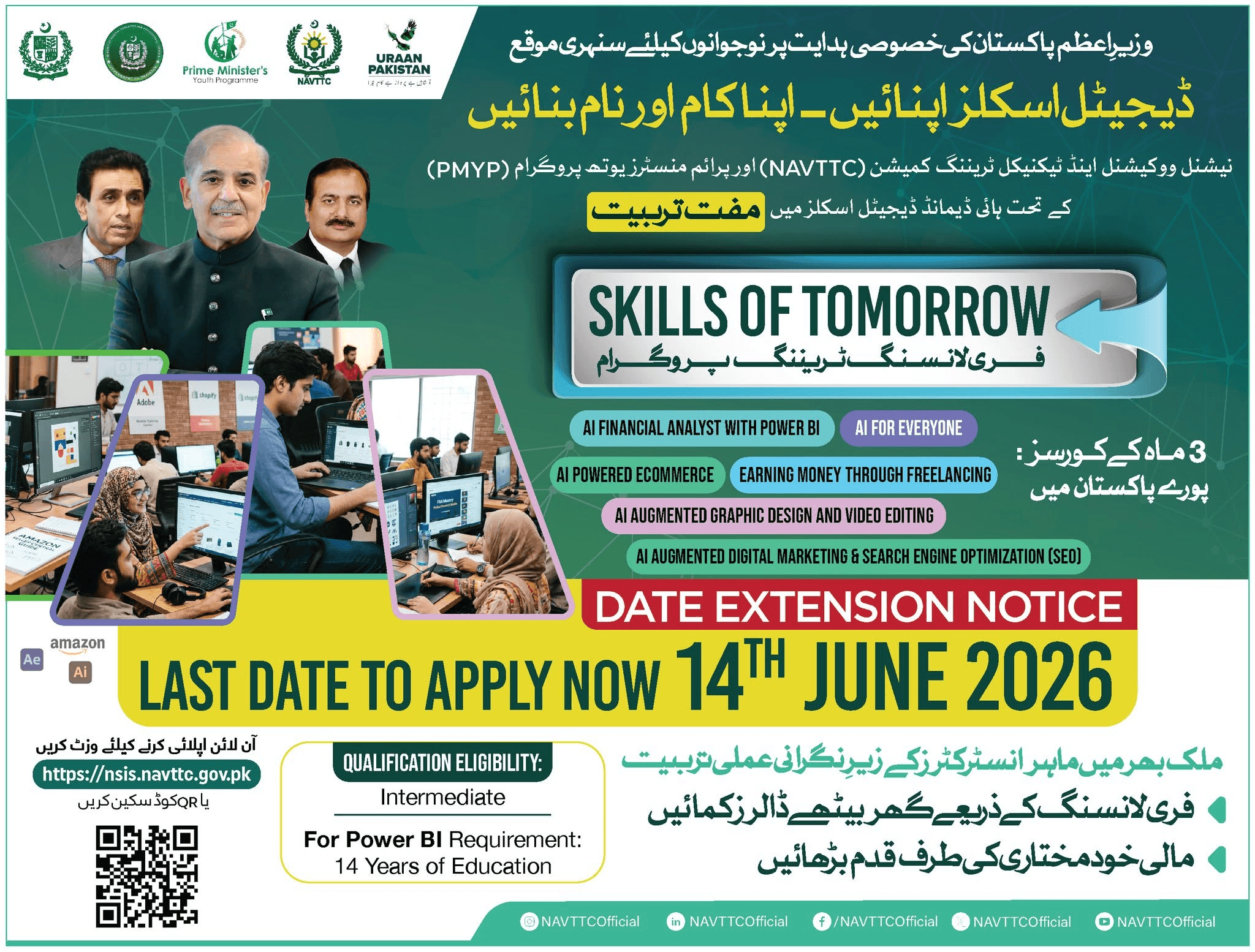
NAVTTC Skills of Tomorrow Program 2026 – Apply Before Deadline
 Follow us on Facebook
 Join our WhatsApp Channel
 Subscribe on YouTube
Artificial Intelligence, Digital Marketing, SEO, Freelancing, Graphic Design, Video Editing — these are not future skills. They are the skills employers are hiring for right now, the skills freelancers on Fiverr and Upwork are earning with right now, and the skills that are reshaping how work happens across every industry.
For most Pakistani students and job seekers, the barrier to learning them is not willingness — it is cost. A quality digital marketing or AI course from a reputable provider can cost tens of thousands of rupees. That amount puts serious training out of reach for a large portion of the people who need it most.
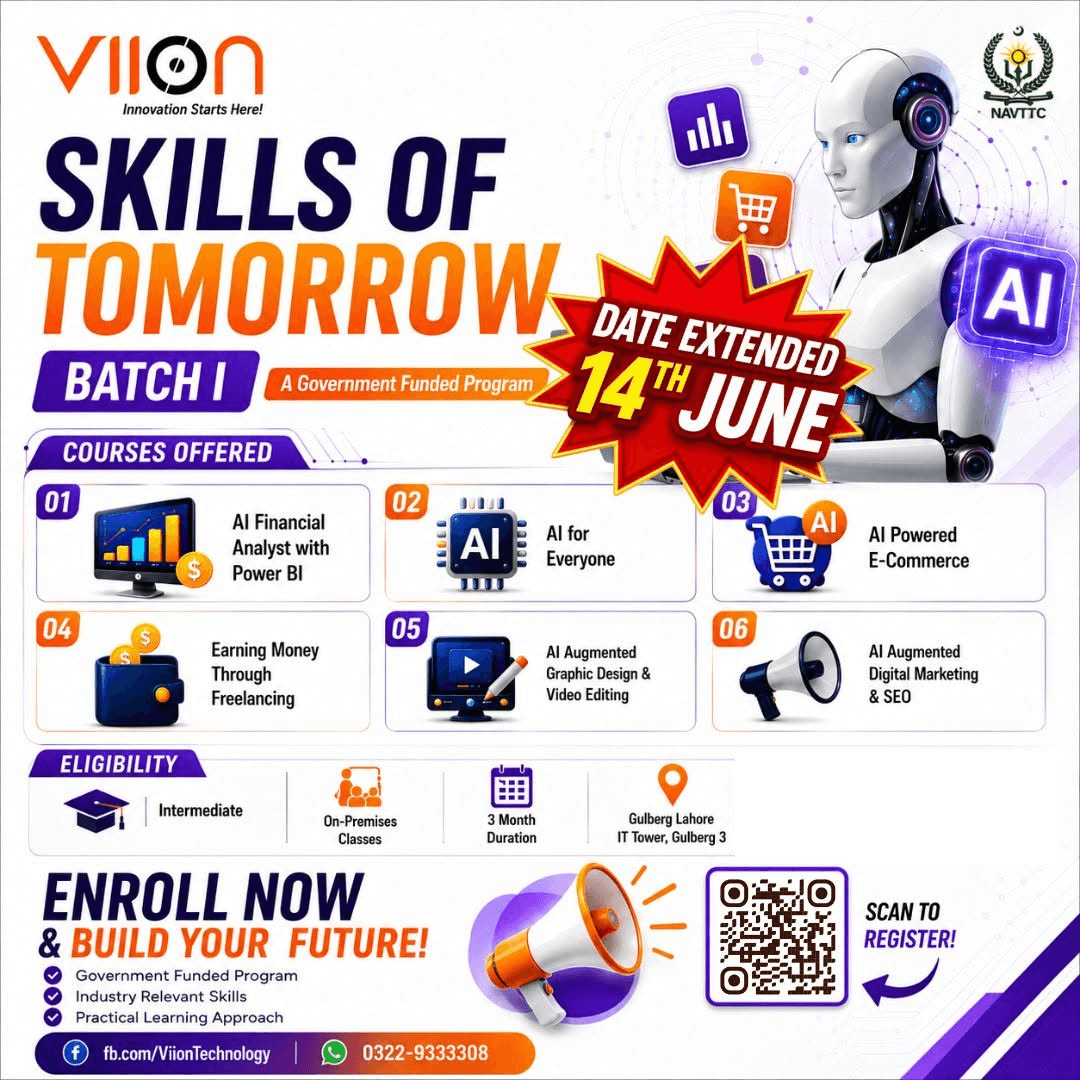
The NAVTTC Skills of Tomorrow Program 2026 removes that barrier entirely. Selected candidates receive three months of professional-level training in their chosen digital field — completely free, through approved institutes across Pakistan. The application deadline has been extended to 14 June 2026, and registration is open now through the NSIS portal.
This guide explains everything: what the program offers, who qualifies, every available course, the complete step-by-step registration process, and exactly what to do — and what not to do — to make sure your application goes through correctly.
- Program: Skills of Tomorrow (SOT) Batch-I — NAVTTC 2026
- Training Fee: 100% Free
- Duration: 3 Months
- Age Limit: 18 to 40 Years
- Minimum Education: Intermediate or above
- Last Date to Apply: 14 June 2026
- Apply At: nsis.navttc.gov.pk
What Is the NAVTTC Skills of Tomorrow Program?
NAVTTC — the National Vocational and Technical Training Commission — is Pakistan’s apex body for technical and vocational education. The Skills of Tomorrow initiative is its response to a clear market reality: the Pakistani workforce needs digital skills, and it needs them now.
The program is not a general computer literacy course. It is a targeted, industry-aligned training initiative covering the specific digital skills that have the highest demand in today’s employment market and on international freelancing platforms. Artificial intelligence tools, search engine optimization, digital marketing, data analysis, e-commerce management, graphic design, video production, and freelancing — these are fields where trained professionals earn significantly more and find work more consistently than those without structured training.
What makes the Skills of Tomorrow Program distinctive is the combination of three things that rarely come together: the training is free, the curriculum is current, and the delivery is through verified institutes with practical learning environments — not just video lectures or PDF handouts.
For a student, a fresh graduate, someone between jobs, or anyone looking to add a monetizable skill alongside whatever they are already doing — this is a legitimate, government-backed pathway into a field that pays.
All Skills in NAVTTC Skills of Tomorrow Batch 1
Six courses are available in the Skills of Tomorrow Batch-I. Each is designed around a real, in-demand skill set. Understanding what each one actually covers helps you choose the one that matches your goals — not just the one with the most familiar name.
1. AI for Everyone
Artificial intelligence is no longer an advanced topic reserved for engineers and programmers. It is a practical tool that is being used by marketers, writers, designers, analysts, and business owners every single day. This course is built for people with no prior technical background who want to understand what AI actually is, how it works in real-world applications, and how to use AI tools productively in professional settings.
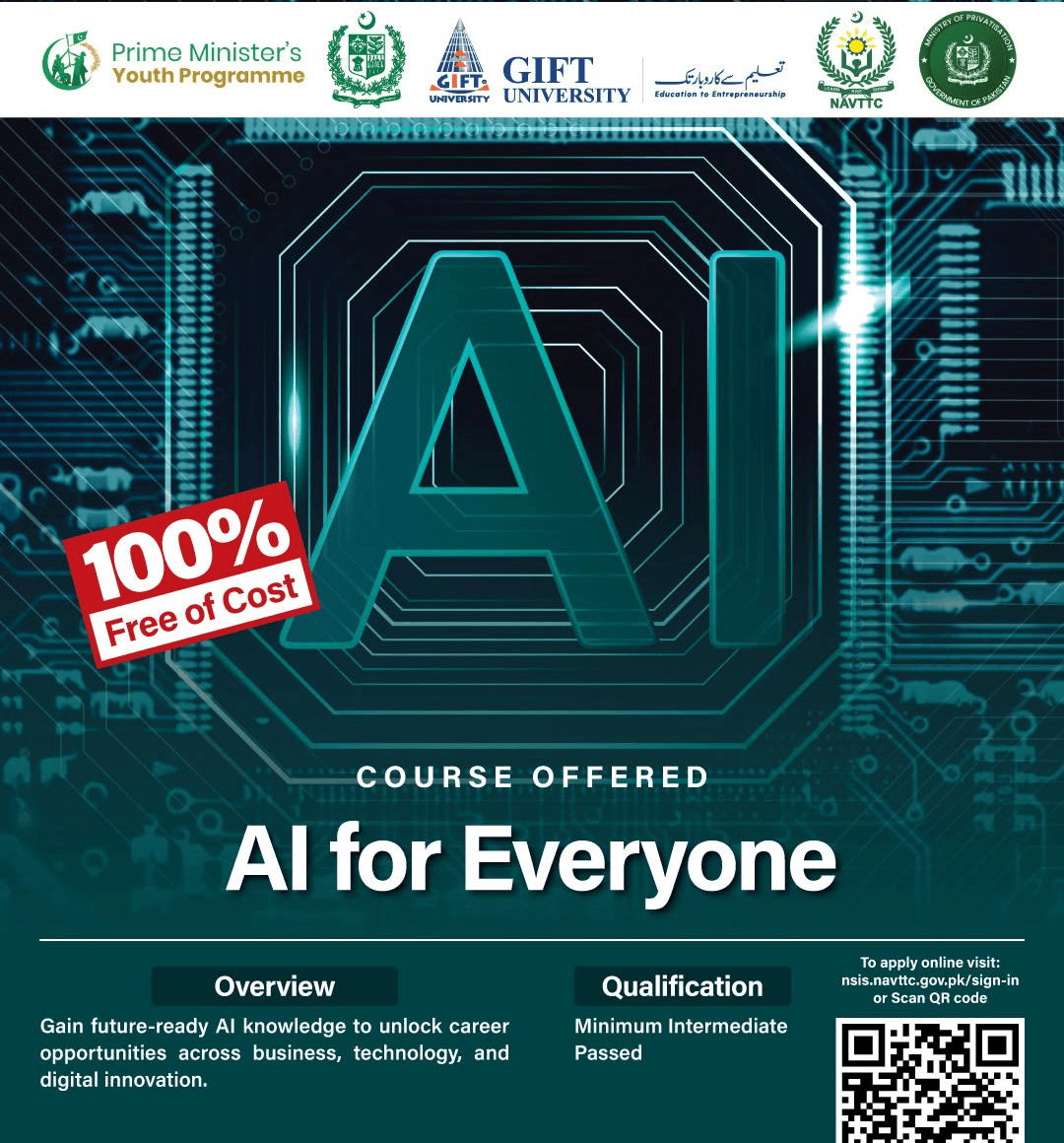
By the end of this course, students should be able to identify AI tools relevant to their field, integrate them into their workflow, and explain AI concepts clearly — a skill increasingly valued in hiring processes across industries.
2. AI-Powered E-Commerce
E-commerce in Pakistan is growing rapidly, and globally it is one of the largest economic sectors. This course covers the full ecosystem of online selling: setting up and managing online stores, product listing and optimization, customer acquisition, using AI tools to automate and improve store performance, and the fundamentals of e-commerce management.
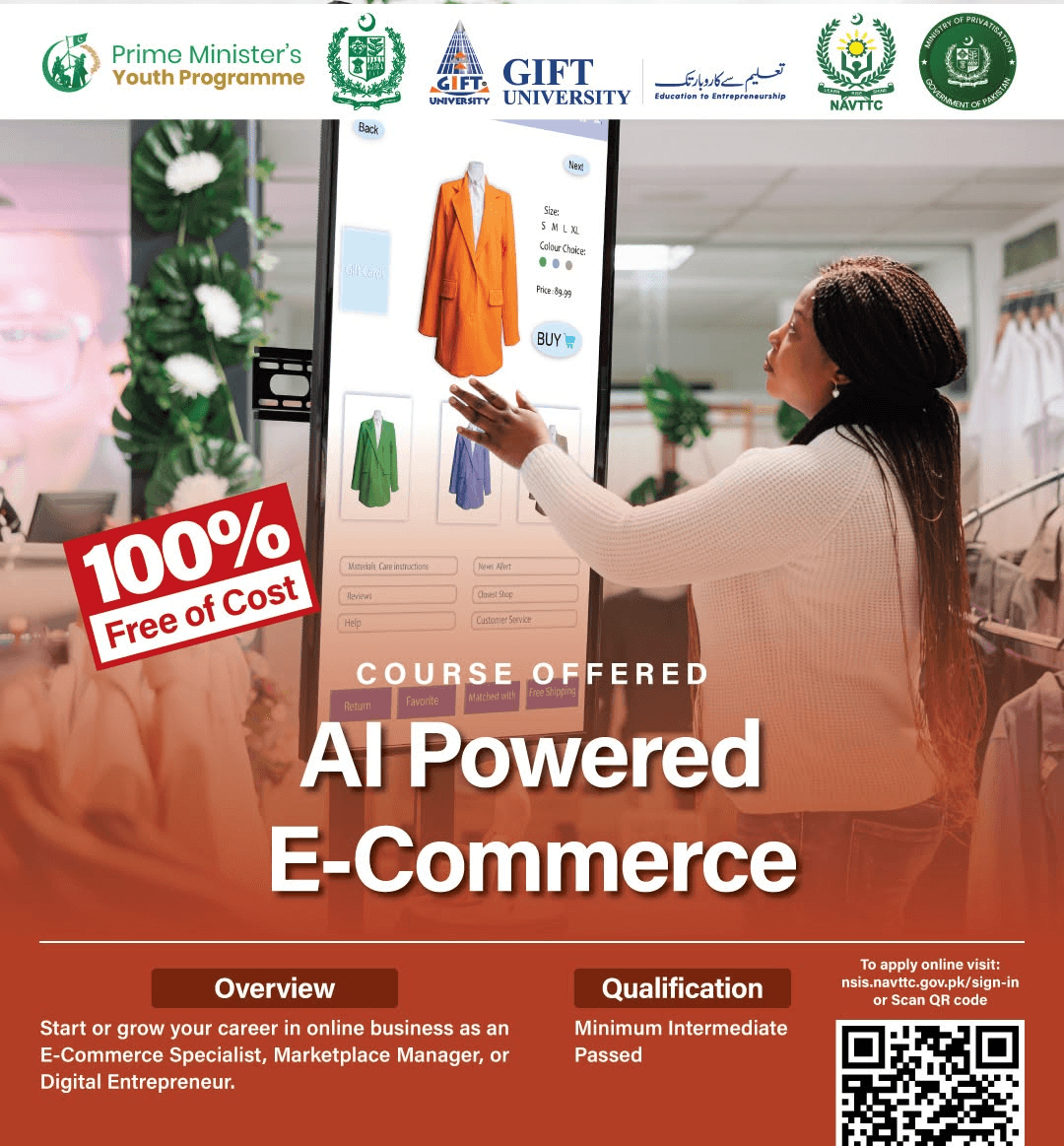
It is particularly suited to students who want to run their own online business, assist existing businesses in moving online, or work in the growing e-commerce operations sector.
3. Graphic Design and Video Editing
Visual content drives online engagement. Every business operating on social media, every brand running digital campaigns, every YouTube channel, and every e-commerce store needs professionally produced graphics and video. This course teaches the tools and techniques used by working designers and video editors — skills with direct, immediate freelancing potential on platforms like Fiverr, Upwork, and PeoplePerHour.

Students who complete this course with genuine practice behind them are in a position to take on client work almost immediately. Design and video editing are among the most consistently hired skills on every major freelancing platform.
4. Digital Marketing and SEO
Search Engine Optimization and digital marketing are among the highest-earning and most reliably in-demand skills in the global freelancing economy. Every business with a website wants to rank higher on Google. Every brand running online campaigns needs people who understand how digital promotion works.
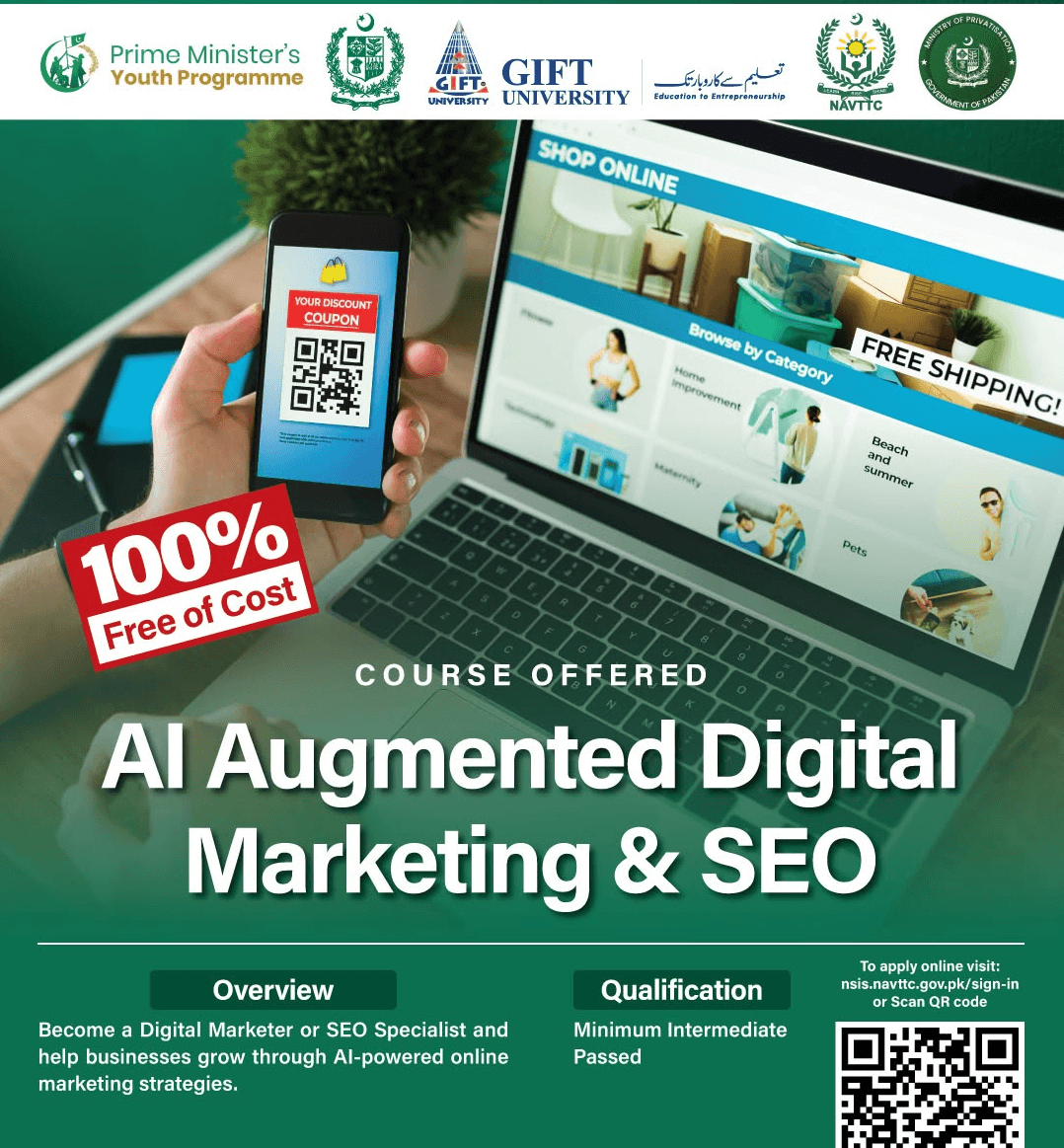
This course covers SEO fundamentals and advanced techniques, content marketing, social media marketing, paid advertising, analytics, and the digital growth strategies that agencies and independent consultants use with clients worldwide. It is one of the most transferable skills in this program — applicable to employment, freelancing, and running your own business simultaneously.
5. Earning Money Through Freelancing
Pakistan consistently ranks among the world’s top countries for freelancing income — and the demand for trained Pakistani freelancers continues to grow. But many people who want to start freelancing get stuck at the beginning: which platform, which niche, how to build a profile that attracts clients, how to communicate professionally, how to price work, and how to actually get that first project.
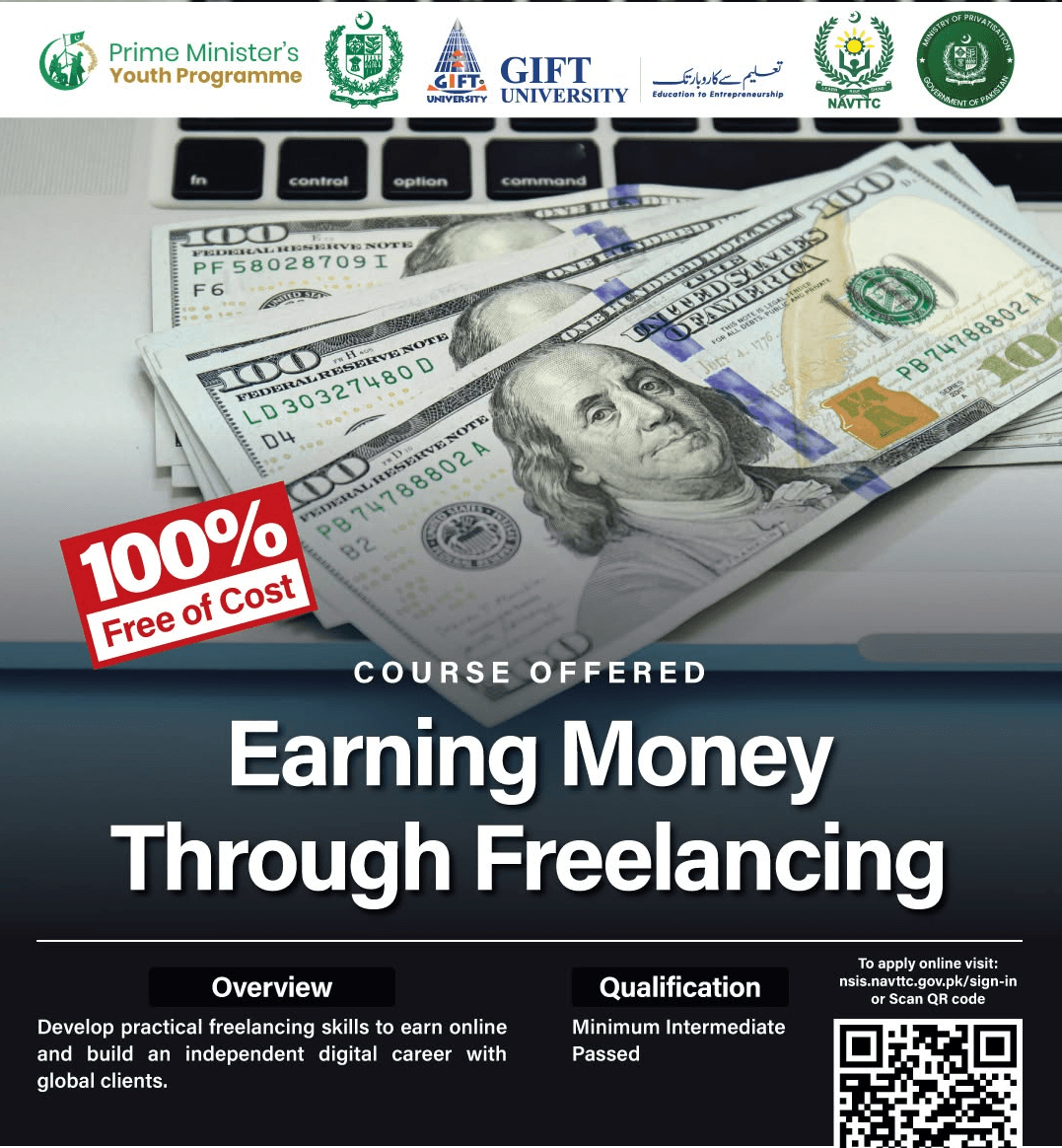
This course addresses all of those barriers systematically. It is structured for complete beginners and covers freelancing platforms, profile optimization, proposal writing, client communication, project management, and the practical path from zero to first earning. For students who have another skill and need to know how to monetize it online, this course is the missing piece.
6. AI Financial Analysis with Power BI
Data analysis is one of the fastest-growing fields in the global job market. Organizations of every size — from startups to multinationals — need people who can take raw data, analyze it meaningfully, and present insights clearly. This course combines AI-based analytical tools with Microsoft Power BI, one of the most widely used business intelligence platforms in the corporate world.

It is best suited to students with some interest in finance, business, or data, and is particularly strong for those aiming at employment in corporate environments, consulting, or analytical roles in government and NGO sectors.
All Six Courses at a Glance:
| Course | Best For |
|---|---|
| AI for Everyone | Beginners wanting to understand and use AI tools practically |
| AI-Powered E-Commerce | Online business and selling — own store or client work |
| Graphic Design and Video Editing | Freelancing and visual content creation for brands and media |
| Digital Marketing and SEO | Online growth, website traffic, brand promotion, client services |
| Earning Through Freelancing | Beginners who want to start earning online from any skill |
| AI Financial Analysis with Power BI | Corporate employment, consulting, data-focused careers |
Eligibility Criteria to Apply for NAVTTC Skills of Tomorrow Program
The eligibility criteria are deliberately broad. NAVTTC has designed this program to reach as many eligible young Pakistanis as possible — not to filter down to a narrow group.
- Nationality: Pakistani citizen
- Age: 18 to 40 years at the time of application
- Education: Intermediate (FSc / FA / ICS / ICom) or higher
- Prior Training: Must not have already received training under the same NAVTTC program
- Who It Suits: Students, fresh graduates, job seekers, freelancers wanting to formalize skills, professionals adding new capabilities, small business owners going digital
One condition worth highlighting: candidates who have already completed a course under the same NAVTTC program are not eligible to apply again for the same initiative. If you completed training under a previous NAVTTC Skills of Tomorrow batch, verify your eligibility before applying to avoid disqualification during verification.
Documents Required for NAVTTC Skills of Tomorrow Registration
Have all of the following ready before you open the NSIS portal. Stopping mid-registration to find documents causes mistakes and wastes time.
How to Apply for NAVTTC Skills of Tomorrow 2026?
The entire process runs through one portal: nsis.navttc.gov.pk. There is no paper form, no in-person visit required at this stage, and no separate email or WhatsApp submission. Everything happens online through this portal only.
Visit the NSIS Portal and Create Your Account
Go to https://nsis.navttc.gov.pk. If you do not already have an account, click Candidate Registration. Fill in the following details:
- Full Name — exactly as on your CNIC
- CNIC Number
- Email Address — one you actively use
- Mobile Number — must be active and with you right now
- Username and Password — choose something you will remember
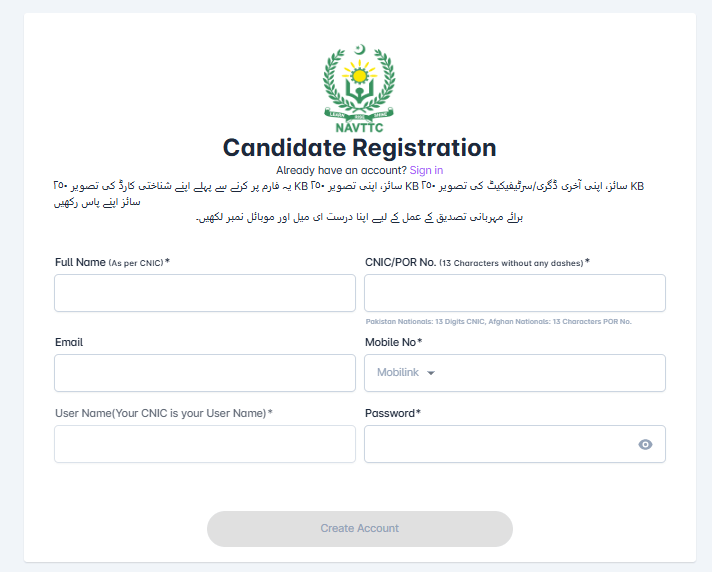
Click Create Account. An OTP will immediately be sent to your registered mobile number. Enter it and click Verify Account. Your account is now active.
Fill Section 1 — Basic Profile
Log in and complete your basic profile. Provide:
- Full Name and Father’s Name
- Gender and Date of Birth
- District, Domicile, and Current Address
You will also see optional special categories — Orphan, Disabled, Hafiz-e-Quran, Widow, Divorced, Sportsman. Select only if genuinely applicable to your situation.
Upload Your Documents — Section 2
Upload your profile photograph and CNIC copy. Before uploading, check that:
- All text on the CNIC is clearly readable — no blur, no cut edges
- The photograph is recent and clearly shows your face
- File formats and sizes are within the portal’s stated limits
Enter Educational Qualifications — Section 3
Enter your academic history accurately:
- Qualification level
- Institution name — as it appears on your certificate
- Passing year and percentage
- Highest qualification completed
Every figure here must match your official documents exactly. Discrepancies are flagged during verification and can delay or disqualify your application.
Select Your Course — Section 4 (Most Critical Step)
This is the most important section in the entire application. Make your selections carefully:
| Field | What to Select |
|---|---|
| Program | Skills of Tomorrow (SOT) Batch-I |
| Sector | Information Technology |
| District | Your district |
| Trade | The course you want to take |
| Institute | Available approved institute in your area |
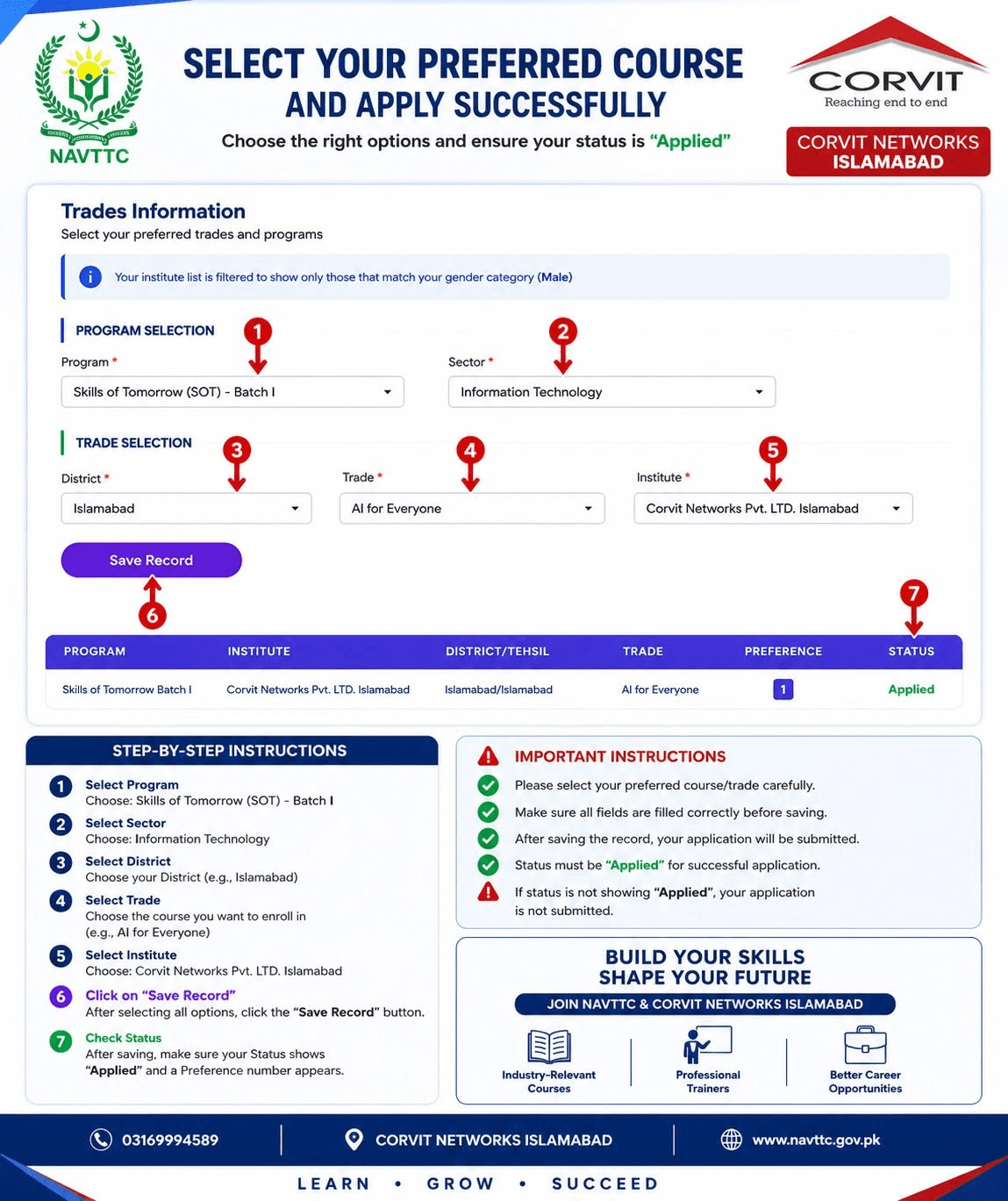
Choose the course you genuinely intend to complete — not just the most popular one. You will spend three months on this. Pick the field that aligns with what you actually want to do.
Submit and Verify Your Application Status
Review everything one final time, then submit. After submission, do not close the portal immediately. Check your application status — it must show:
✅ Status = Applied
If the status shows “Applied,” your application has been received. If it shows anything else, do not assume it went through — investigate immediately. Many candidates assume submission was successful without verifying and discover later that their application was incomplete.
Mistakes That Get Applications Rejected or Ignored
These are not rare edge cases. They happen in large numbers every time a program like this opens. Every single one of them is avoidable:
| 1. | Entering an inactive or wrong mobile number. The OTP arrives immediately during registration. If the number is wrong, switched off, or not with you, verification fails and registration stops. Use the number that is in your hand right now. |
| 2. | Uploading blurry or unreadable documents. If the verification team cannot read your CNIC number or see your name on your certificate, your application fails at the document check stage. Scan clearly and zoom in to confirm text is fully readable before uploading. |
| 3. | Leaving sections of the profile incomplete. An incomplete profile does not pass processing. Every required section must be fully filled — not partially. Do not rush through sections or skip fields you are unsure about. |
| 4. | Education details that do not match certificates. If the percentage, institution name, or passing year entered in the form differs from your actual document — even slightly — it creates a discrepancy during verification. Cross-reference your certificate before entering anything. |
| 5. | Not checking the application status after submission. Submitting is not the same as confirming submission. Always check that your status shows “Applied” before closing the portal. Assumption is not confirmation. |
| 6. | Applying on 14 June. Portal traffic peaks on deadline day. Slowdowns, timeouts, and submission failures increase dramatically. Apply at least five to seven days before the deadline. There is no benefit to waiting — and real risk in doing so. |
Frequently Asked Questions — NAVTTC Skills of Tomorrow 2026
3 months of free, structured training in a skill the market is paying for. The window closes on 14 June 2026.
Go to nsis.navttc.gov.pk today. Create your account. Have your CNIC, photo, and certificate ready. Fill every section completely. Choose the course that matches where you want to go. Verify your status shows “Applied” before you close the tab.
The skills taught in this program are genuinely marketable — in employment, in freelancing, and in building something of your own. The only thing this opportunity costs you is the time it takes to apply. Apply now — not on 13 June.