
Agriculture Lab on Wheels Punjab 2026 | Complete Guide for Farmers
 Follow us on Facebook
 Join our WhatsApp Channel
 Subscribe on YouTube
A farmer in rural Punjab has been working the same land for twenty years. His yields are dropping. He adds more fertilizer every season — spending money he cannot afford to waste — and still the crops do not improve. He does not know why.
The answer is in his soil. But the nearest laboratory is hours away, the process is unfamiliar, and the cost of getting there and back is another burden on top of everything else.
The Agriculture Lab on Wheels programme was launched for exactly this farmer — and for every farmer like him across Punjab.
What Is the Agriculture Lab on Wheels Programme?
The Agriculture Lab on Wheels is a mobile laboratory programme launched under the direction of Chief Minister Punjab Maryam Nawaz Sharif. It is operated by the Punjab Agriculture Department and is designed to bring modern soil and water testing services directly to farmers — in their own villages, at their own fields, without them ever needing to travel to a city.
The concept is straightforward but genuinely transformative. Instead of a farmer having to find a laboratory, understand the process, travel long distances, pay for transport, and then wait for results — a fully equipped mobile laboratory comes to his area. Trained agricultural experts are on board. Testing happens on the spot. Results and guidance are provided the same day.
For millions of small farmers across Punjab who have been making decisions based on guesswork and tradition rather than scientific data, this programme represents something they have never had access to before: accurate, personalized, evidence-based guidance for their own specific land and water.
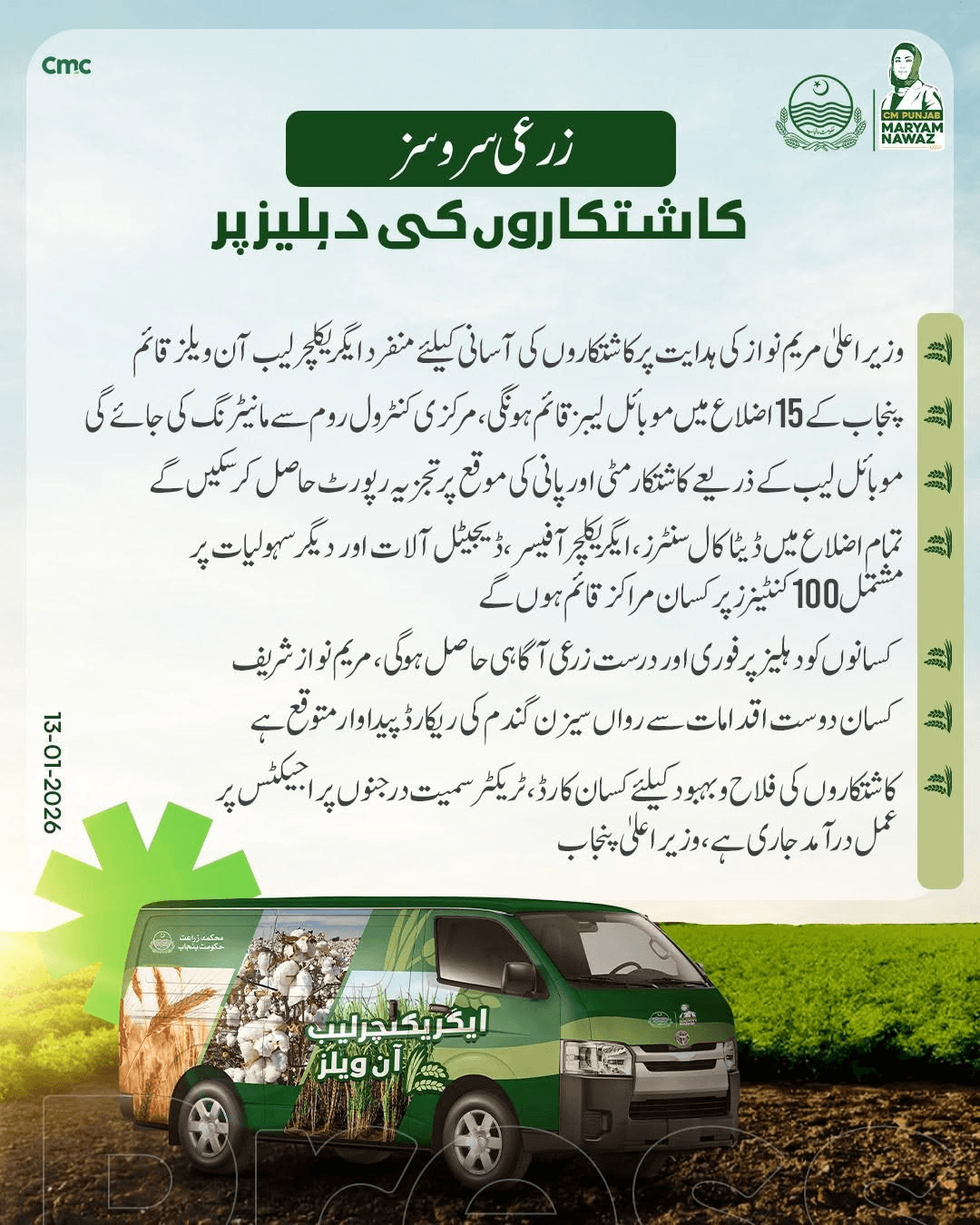
- Programme Name: Agriculture Lab on Wheels Punjab
- Launched By: CM Punjab Maryam Nawaz Sharif
- Managed By: Punjab Agriculture Department
- Service: Free soil and water testing at the farmer’s location
- Current Coverage: 15 districts across Punjab
- Helpline: 0800-17000 (toll free)
- Cost to Farmer: Free
Why Did Punjab Need This Programme?
Punjab is Pakistan’s largest agricultural province. It feeds a significant portion of the country. But for decades, a fundamental problem has persisted beneath the surface — quite literally.
Most farmers in Punjab — especially small and medium landholders — have no scientific understanding of what is actually in their soil or their water. They apply fertilizer based on what their fathers did, what their neighbors recommend, or what a shopkeeper suggests. Sometimes they apply too much. Sometimes the wrong type entirely. Sometimes the real problem is not the soil at all — it is the water they are using for irrigation.
The consequences are significant and compounding:
Agriculture Lab on Wheels directly attacks every one of these problems. It brings the science to the farmer — not the other way around.
How Does the Agriculture Lab on Wheels Laboratory Actually Work?
Understanding exactly what happens when the mobile lab arrives at your area removes any confusion or hesitation. Here is the full process from arrival to guidance:
The Agriculture Lab on Wheels is a specially designed vehicle containing complete laboratory equipment and a team of trained agricultural experts. When it arrives at a designated location — a village center, a field area, or a nearby accessible point — farmers bring their soil or water samples to the vehicle.
The on-board experts receive the samples and run the required tests. Results are analyzed within the same visit where possible. Based on the test results, each farmer receives a personalized written report along with direct guidance from the agricultural officer on what the results mean for their specific situation.
This guidance covers what nutrients are deficient, which fertilizer is appropriate, how much to apply, whether the water source is safe for the crops they are growing, and what practical steps to take to improve yields in the coming season.

What Tests Are Performed in the Mobile Lab?
The Agriculture Lab on Wheels is equipped to run a comprehensive range of soil and water analysis tests. Here is a complete breakdown of what is tested and why each test matters:
Soil Testing
Water Quality Testing
These tests collectively give a farmer a complete scientific picture of the two most fundamental inputs in farming — the land itself and the water used to grow on it.
What Benefits Will Farmers Actually See?
Some government programmes sound good in announcements but deliver little change on the ground. The benefits of this programme are concrete, practical, and directly tied to a farmer’s income and daily costs. Here is what the data-driven approach actually delivers:
1. Lower Fertilizer Costs — Immediately
- This is perhaps the most immediate financial benefit. The majority of farmers in Punjab apply far more fertilizer than their soil actually needs — because without a test, there is no way to know. When the soil report shows that a field already has sufficient phosphorus levels, for example, the farmer does not buy phosphate fertilizer that season. That is direct money saved — sometimes thousands of rupees per acre per season — with no negative impact on yield. In fact, the yield often improves because the correct deficit is being addressed instead.
2. Higher Crop Yields — Season After Season
- When a crop receives the exact nutrients it is missing — not a general mix based on guesswork — the results are measurable. Zinc deficiency alone, which is widespread across Punjab soils and almost invisible without a test, can reduce wheat and rice yields by 20 to 40 percent. Correcting that one deficiency based on accurate soil data can mean dramatically more output from the exact same amount of land, water, and labor.
3. Water Problems Identified Before They Damage Crops
- Many farmers in Punjab unknowingly irrigate with water that is saline, alkaline, or otherwise unsuitable for their crops. The damage builds up slowly over years — soil becomes progressively less productive, and the farmer cannot identify why. Water quality testing through the mobile lab identifies these problems immediately, allowing the farmer to switch sources, adjust irrigation frequency, or take corrective action before permanent damage is done.
4. Time and Travel Cost Eliminated
- Before this programme, a farmer who wanted soil testing had to identify a laboratory, arrange transport to a city, take time away from his land, pay for the journey, pay testing fees, wait for results, travel back, and then try to interpret a technical report without any expert guidance. For a small farmer with limited resources and a busy agricultural calendar, this chain of barriers was effectively insurmountable. Now the entire process comes to him — at no cost.
5. Expert Guidance in Plain Language
- A soil report full of numbers means nothing to a farmer who has never seen one before. The mobile lab team does not just hand over a document and leave. They sit with the farmer, explain what each result means in practical terms, tell him exactly which fertilizer to buy, how much per acre, when to apply it, and what to expect. That translation from data to actionable advice is what makes the programme genuinely useful rather than just technically impressive.
Which 15 Districts Are Currently Covered?
The Agriculture Lab on Wheels programme has been launched in the first phase across 15 districts of Punjab. These are primarily major agricultural districts where the concentration of farming communities and the need for soil health intervention is highest.
Phase 1 — Covered Districts:
| District | District | District |
|---|---|---|
| Multan | Lodhran | Bahawalpur |
| Bahawalnagar | Rahim Yar Khan | Faisalabad |
| Chiniot | Khushab | Bhakkar |
| Layyah | Sahiwal | Okara |
| Nankana Sahib | Gujrat | Attock |
If your district is on this list — do not miss the mobile lab when it comes to your area. The service is free, the guidance is expert-level, and the potential impact on your farming is significant.
What If Your District Is Not on the List?
If your district is not currently included in Phase 1, there is still good news. The Punjab Government has announced a parallel plan to establish 100 Container-Based Farmer Facilitation Centers across Punjab. These permanent centers will provide:
- Resident Agriculture Officers available for ongoing advice and guidance
- Digital Facilities for accessing agricultural information and government services
- Data Call Centers for remote support and query resolution
- Technical Guidance on soil health, crop management, water use, and more
Additionally, you can always call the Agriculture Helpline at 0800-17000 (toll free) for information about when and where the mobile lab is scheduled to visit your area, and for any agricultural guidance in the meantime.
What to Do When the Agriculture Lab on Wheels Arrives in Your Area
When the Agriculture Lab on Wheels comes to your village or area, being prepared makes the entire process faster and the results more accurate. Here is exactly what to do:
Collect Soil Samples From Your Field — The Right Way
This step matters more than most people realize. A sample taken incorrectly will produce results that do not accurately represent your field — and inaccurate results lead to wrong recommendations. Follow these steps precisely:
- Collect samples from 5 to 10 different spots across your field — do not take everything from one place
- Dig to a depth of approximately 6 inches at each spot
- Remove any stones, grass, roots, or plant material from each sample
- Mix all the samples together thoroughly in a clean container
- Take approximately 500 grams of this mixed sample as your final test sample
- Place it in a clean, dry plastic bag and label it with your name and field location
Collect a Water Sample if Needed
If you want your irrigation water tested as well — and this is strongly recommended — collect a water sample following these steps:
- Use a clean, dry plastic bottle — wash it out first with the same water you are collecting
- Collect fresh water directly from your irrigation source — tube well, canal, or stream
- Fill the bottle completely and seal it tightly
- Bring it to the lab as soon as possible — water samples should be tested fresh
Visit the Mobile Lab and Submit Your Samples
- Bring your soil and water samples to the mobile lab vehicle when it arrives in your area. The staff will receive your samples, register your details, and begin the testing process. There is no charge for this service.
Receive Your Report and Ask Every Question You Have
Once testing is complete, you will receive a written report. Do not just take the paper and leave. Sit with the agricultural expert and go through it properly. Ask:
- Which specific fertilizer should I buy — and which brand or type is best?
- How much should I apply per acre?
- When exactly should I apply it — before planting, after, or during growth?
- Is my water safe for the crops I am planning to grow?
- What should I do differently next season?
Follow the Recommendations and Track the Results
- The most important step is acting on what the report tells you. Apply the recommended fertilizer at the recommended quantity and time. Note how your crops perform that season compared to before. Most farmers who follow soil test recommendations see a visible improvement in yields within the very first season of applying the guidance correctly.
You may also like: BISP Mobile Registration Vans 2026: What to Do When They Arrive
Common Mistakes Farmers Make With Soil Testing
Even with a free mobile lab at your doorstep, these mistakes can reduce the value of what you get from the service:
| 1. | Taking a sample from only one spot. One location does not represent the entire field. Soil varies significantly even within a small area. Always collect from 5 to 10 different points and mix them together. A single-spot sample produces misleading results. |
| 2. | Not removing plant material from the sample. Roots, grass, and organic debris in the sample affect the test results. Always clean your samples before mixing them. |
| 3. | Taking the report but not asking for guidance. The written report alone, without expert explanation, is only half the value. The agricultural officer at the mobile lab is there specifically to explain what it means. Use that person. Ask every question you have. |
| 4. | Skipping the water test. Many farmers only test their soil and assume the water is fine. Water quality problems are just as damaging — and just as fixable — as soil deficiencies. Always test both when you have the chance. |
| 5. | Going back to the old guesswork approach the following season. One soil test is not a permanent solution. Soil health changes over time. If the mobile lab returns to your area next year, test again. Scientific farming is an ongoing practice, not a one-time event. |
You may also like: Punjab Free Public Transport & Relief Package 2026 – Everything You Need to Know
Quick Summary — Everything in One Place
- Programme: Agriculture Lab on Wheels Punjab 2026
- Launched By: CM Punjab Maryam Nawaz Sharif — Punjab Agriculture Department
- Services: Free soil testing and water quality testing at your location
- Who Can Use It: All farmers in the covered districts — no registration required
- Cost: Completely free
- Current Coverage: Multan, Lodhran, Bahawalpur, Bahawalnagar, Rahim Yar Khan, Faisalabad, Chiniot, Khushab, Bhakkar, Layyah, Sahiwal, Okara, Nankana Sahib, Gujrat, Attock
- Helpline: 0800-17000 (toll free)
The successful farmer of today does not guess. He knows.
He knows what his soil needs. He knows whether his water is safe. He knows exactly which fertilizer to buy and exactly how much to apply. And now — for the first time — every farmer in Punjab has access to that knowledge, completely free, delivered directly to his area.
When the Agriculture Lab on Wheels comes to your village, do not let it leave without testing your soil and water. Prepare your samples properly. Ask every question you have. Follow the recommendations that season.
For more information or to find out when the mobile lab will be in your area, call the Punjab Agriculture Helpline:
☎️ 0800-17000 (Toll Free)
Because better soil data means better crops. Better crops mean better income. And better income means a better life. Stay Connected – Keep Visiting Allprograms.com.pk